The electromotive force of a primary cell is $2\, volts$. When it is short-circuited it gives a current of $4$ amperes. Its internal resistance in $ohms$ is
Easy


Download our appand get started for free
Experience the future of education. Simply download our apps or reach out to us for more information. Let's shape the future of learning together!No signup needed.*
Similar Questions
- 1View SolutionAssertion : The electric bulbs glows immediately when switch is on.
Reason : The drift velocity of electrons in a metallic wire is very high.
- 2View SolutionWhich among the following is true
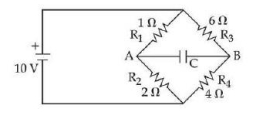
- 3The charge accumulated on the capacitor connected in the following circuit is________ $\mu \mathrm{C}$ (Given $\mathrm{C}=150\ \mu \mathrm{F}$ )View Solution
- 4A current of $2\,A$ flows through a wire of crosssectional area $25.0\,mm ^2$. The number of free electrons in a cubic meter are $2.0 \times 10^{28}$. The drift velocity of the electrons is $...............\times 10^{-6}\,ms ^{-1}$ (given, charge on electron $=1.6 \times 10^{-19}\,C$ )View Solution
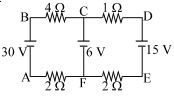
- 5View SolutionThe figure shows a network of four resistances and three batteries Which of the battery is getting charged.
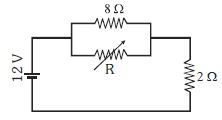
- 6The value of the resistance $R$ in figure is adjusted such that power dissipated in the $2\,\Omega $ resistor is maximum. Then the power dissipated in the $2\,\Omega $ will be ................ $W$View Solution
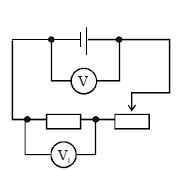
- 7If the rheostat slider were to move from the extreme right to the far left, How will the reading of voltmeter $V_1$ change?View Solution
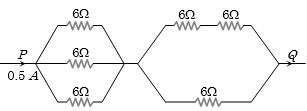
- 8Resistances of $6\, ohm$ each are connected in the manner shown in adjoining figure. With the current $0.5\,ampere$ as shown in figure, the potential difference ${V_P} - {V_Q}$ is .............. $V$View Solution
- 9View SolutionAssertion : In a simple battery circuit, the point of the lowest potential is negative terminal of the battery.
Reason : The current flows towards the point of the higher potential, as it does in such a circuit from the negative to the positive terminal.
- 10When a wire of uniform cross-section $a$, length $l$ and resistance $R$ is bent into a complete circle, resistance between any two of diametrically opposite points will beView Solution