MCQ
The electron emitted in beta radiation originates from:
- AInner orbits of atoms
- BFree electrons existing in nuclei
- CDecay of a neutron in a nucleus
- DPhoton escaping from the nucleus
Explanation:
The electron emitted in beta radiation may originates from neutron and it increases the atomic number 1.
Generate a complete, print-ready paper with questions like this in minutes — across 16+ boards, with answer keys.
If a slab of insulating material 4  thick is introduced between the plates of a parallel plate capacitor, the separation between plates has to be increased by 3.5 to restore the capacity to original value. The dielectric constant of the material will be
|
(a) 6 |
(b) 8 |
(c) 10 |
(d) 12 |
If the voltage of X-ray tube is doubled, the intensity of X-rays will become
|
(a) Half |
(b) Unchanged |
(c) Double |
(d) Four times |
Assertion : The 200 W bulbs glows with more brightness then 100 W bulbs.
Reason : A 100 W bulb has more resistance than a 200 W bulb.
|
(a) If both assertion and reason are true and the reason is the correct explanation of the assertion. |
|
(b) If both assertion and reason are true but reason is not the correct explanation of the assertion. |
|
(c) If assertion is true but reason is false. |
|
(d) If the assertion and reason both are false. |
In Young's double slit experiment, the distance between the two slits is 0.1 mm and the wavelength of light used is 4 . If the width of the fringe on the screen is 4 mm, the distance between screen and slit is
|
(a) 0.1 mm |
(b) 1 cm |
(c) 0.1 cm |
(d) 1 m |
$\overrightarrow{\text{F}}.\overrightarrow{\text{a}}$
$\overrightarrow{\text{v}}.\overrightarrow{\text{r}}$
$\overrightarrow{\text{a}}.\overrightarrow{\text{r}}$
$\overrightarrow{\text{F}}.\overrightarrow{\text{r}}$
In the following common emitter configuration an NPN transistor with current gain b = 100 is used. The output voltage of the amplifier will be
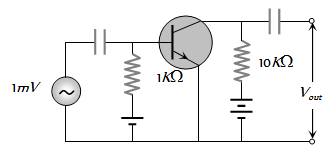
|
(a) 10 mV |
(b) 0.1 V |
(c) 1.0 V |
(d) 10 V |