MCQ
The electron emitted in beta radiation originates from:
  • A
    Inner orbits of atoms
  • B
    Free electrons existing in nuclei
  • Decay of a neutron in a nucleus
  • D
    Photon escaping from the nucleus

Answer

Correct option: C.
Decay of a neutron in a nucleus

The electron emitted in beta radiation may originates from neutron and it increases the atomic number $1.$

Need a full question paper?

Generate a complete, print-ready paper with questions like this in minutes — across 16+ boards, with answer keys.

Start Generating Free

Similar questions

Assertion : In optical fibre, the diameter of the core is kept small.

Reason : This smaller diameter of the core ensures that the fibre should have incident angle more than the critical angle required for total internal reflection.
Assertion : Charge is invariant.
Reason : Charge does not depends on speed of frame of reference.
In sum and difference method in vibration magnetometer, the time period is more if
Field at the centre of a circular coil of radius r, through which a current I flows is
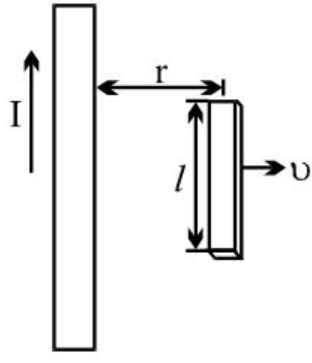
A long metal bar of $30 \ cm$ length is aligned along a north south line and moves eastward at a speed of $10 ms^{-1}$. A uniform magnetic field of $4.0 T$ points vertically downwards. If the south end of the bar has a potential of $0 V$ , the induced potential at the north end of the bar is:
Image
A man who cannot see clearly beyond 5 m wants to see stars clearly. He should use a lens of focal length
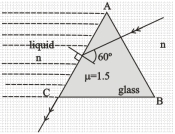
In the given figure, the face $AC$ of the equilateral prism is immersed in a liquid of refractive index ' $n$ '. For incident angle $60^{\circ}$ at the side $AC$, the refracted light beam just grazes along face $AC$. The refractive index of the liquid $n =\frac{\sqrt{ x }}{4}$. The value of $x...$ is (Given refractive index of glass $=1.5$ )
An electric bulb rated as $200\, {W}$ at $100 \,{V}$ is used in a circuit having $200\, {V}$ supply. The resistance $'R'$ that must be put in series with the bulb so that the bulb delivers the same power is $.....\,\Omega$
A parallel monochromatic beam of light is incident normally on a narrow slit. A diffraction pattern is formed on a screen placed perpendicular to the direction of incident beam. At the first maximum of the diffraction pattern the phase difference between the rays coming from the edges of the slit is
A Charged particle of mass $m$ and charge $q$ is released from rest in a uniform electric field $E.$ Neglecting the effect of gravity, the kinetic energy of the charged particle after $'t'$ second is