MCQ
The electron pair which forms a bond between two similar non-metallic atoms will be
  • A
    Dissimilar shared between the two
  • B
    By complete transfer from one atom to other
  • C
    In a similar spin condition
  • Equally shared in between the two

Answer

Correct option: D.
Equally shared in between the two
(d) Similar atoms form covalent bond.

Need a full question paper?

Generate a complete, print-ready paper with questions like this in minutes — across 16+ boards, with answer keys.
Start Generating Free

Similar questions

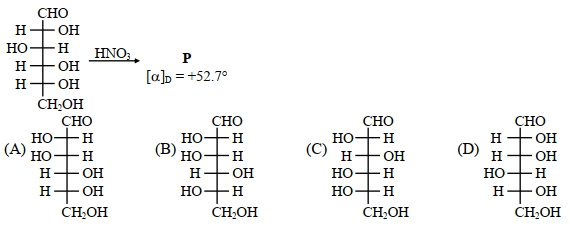
Given  $D$-Glucose  The compound($s$), which on reaction with $HNO _3$ will give the product having degree of rotation, $[\alpha]_{ D }=-52.7^{\circ}$ is (are)
The solubility of a salt $A_2B_3$ is $10^{-3}\, M$ then what will be its solubility product ?
First ionization energy is the lowest with
The formation of starch in plants results from
On treatment of 100 mL of 0.1 M solution of $CoCl _3 .6 H _2 O$ with excess $AgNO _3 ; 1.2 \times 10^{22}$ ions are precipitated. The complex is :
To get $DDT, $ chlorobenzene has to react with which of the following compounds in the presence of concentrated sulphuric acid
The $IUPAC$ name of the compound having the formula is

$\begin{matrix}
   C{{H}_{3}}\,\,\,\,\,\,\,  \\
   |\,\,\,\,\,\,\,\,\,\,\,\,\,\,\,\,  \\
   {{H}_{3}}C-C-CH=C{{H}_{2}}  \\
   |\,\,\,\,\,\,\,\,\,\,\,\,\,\,\,\,\,  \\
   C{{H}_{3}}\,\,\,\,\,\,\,\,\,  \\
\end{matrix}$
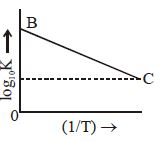
Following figure shows a graph in $log_{10}K$ vs $\frac{1}{T}$ where $K$ is rate constant and $T$ is temperature. The straight line $BC$ has slope, $tan\,\theta  = -\frac{1}{2.303}$ and an intercept of $5$ on $Y-$ axis. Thus $E_a$, the energy of activation is ....... $cal$
$(A) + C{l_2}\xrightarrow{{hv}}$ monochloro product
To maximise the yield of monochloro product in the above reaction ?
The correct statement$(s)$ about the compound $\mathrm{H}_3 \mathrm{C}(\mathrm{HO}) \mathrm{HC}-\mathrm{CH}=\mathrm{CH}-\mathrm{CH}(\mathrm{OH}) \mathrm{CH}_3(\mathbf{X})$ is(are)

$(A)$ The total number of stereoisomers possible for ${X}$ is $6$

$(B)$ The total number of diastereomers possible for ${X}$ is $3$

$(C)$ If the stereochemistry about the double bond in ${X}$ is trans, the number of enantiomers possible for ${X}$ is $4$

$(D)$ If the stereochemistry about the double bond in ${X}$ is cis, the number of enantiomers possible for ${X}$ is $2$