MCQ
The electronic conductane does not depend on _______________
  • concentration of the electrolyte
  • B
    the number of valance electrons per atom
  • C
    temperature
  • D
    the nature and structure of the metal

Answer

Correct option: A.
concentration of the electrolyte
A

Need a full question paper?

Generate a complete, print-ready paper with questions like this in minutes — across 16+ boards, with answer keys.
Start Generating Free

Similar questions

$\begin{array}{*{20}{c}}
  {O\,\,\,\,\,\,\,\,\,\,\,\,\,\,\,\,\,\,\,\,\,\,\,\,\,\,\,\,\,\,\,\,\,\,\,\,\,\,\,\,\,\,\,\,\,\,\,\,\,\,\,\,} \\ 
  {||\,\,\,\,\,\,\,\,\,\,\,\,\,\,\,\,\,\,\,\,\,\,\,\,\,\,\,\,\,\,\,\,\,\,\,\,\,\,\,\,\,\,\,\,\,\,\,\,\,\,\,\,} \\ 
  {Ph - C - OH\xrightarrow[\Delta ]{{N{H_3}}}(A){\mkern 1mu} \xrightarrow[{KOH}]{{B{r_2}}}(B),{\mkern 1mu} } 
\end{array}{\mkern 1mu} {\mkern 1mu}$  product $B$  is
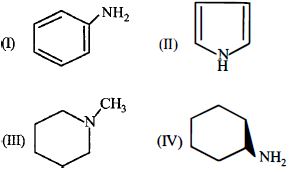
Among the following compounds, the increasing order of their basic strength is
Which one among the following non-metals liquid at ${25^o}C$
On the basis of the information available from the reaction $\frac{4}{3}Al + {O_2} \to \frac{2}{3}A{l_2}{O_3},\Delta G = - 827\,\,kJ\,mo{l^{ - 1}}$ of ${O_2}$, the minimum emf required to carry out an electrolysis of $A{l_2}{O_3}$ is $(F = 96500\,C \,mo{l^{ - 1}})$ ................ $\mathrm{V}$
The addition of a polar solvent to a solid electrolyte results in
$\begin{matrix}
   \,\,\,Br\,\,\,Br  \\
   |\,\,\,\,\,\,\,\,|  \\
   C{{H}_{3}}-C-C-C{{H}_{3}}  \\
   |\,\,\,\,\,\,\,\,|  \\
   \,\,Br\,\,\,Br  \\
\end{matrix}\xrightarrow{xNaN{{H}_{2}}}\xrightarrow{y\,C{{H}_{3}}I}C{{H}_{3}}-C\equiv C-C\equiv C-C{{H}_{3}}$

 $x$ and $y$ mole consumed. Value of $x + y =$

in the change ${[Cu({H_2}{O_6})]^{2 + }}\,\xrightarrow{{HCl}}\,{[CuCl{({H_2}O)_5}]^ + }$, the colour changes from
At $25\,^oC$, calculate equilibrium constant for the cell reaction,

${X_{\left( s \right)}} + Y_{\left( {aq} \right)}^{ + 2} \rightleftharpoons {Y_{\left( s \right)}} + X_{\left( {aq} \right)}^{2 + }$

Given : 

$E_{{x^{ + 2}}/x}^o =  - 1.36\,volt$ ;   

$E_{{y^{ + 2}}/y}^o =  - 0.76\,volt\,\frac{{2.303\,RT}}{F} = 0.06$

$40\, \mathrm{~g}$ of glucose (Molar mass $=180$ ) is mixed with $200\, \mathrm{~mL}$ of water. The freezing point of solution is $.....\,\mathrm{K}$. (Nearest integer)

[Given : $\mathrm{K}_{\mathrm{f}}=1.86 \,\mathrm{~K} \,\mathrm{~kg} \,\mathrm{~mol}^{-1} ;$ Density of water $=$ $1.00 \,\mathrm{~g}\, \mathrm{~cm}^{-3} ;$ Freezing point of water $\left.=273.15\, \mathrm{~K}\right]$

The anion of acetylacetone $(acac)$ forms $Co\, (acac)_3$ chelate with $Co^{3+}.$ The rings of the chelate are