MCQ
The electronic configuration of calcium ion $(C{a^{2 + }})$ is
- A$1{s^2},2{s^2}2{p^6},3{s^2}3{p^6},4{s^2}$
- B$1{s^2},2{s^2}s{p^6},3{s^2}3{p^6},4{s^1}$
- C$1{s^2},2{s^2}2{p^6},3{s^2}3{p^6}3{d^2}$
- ✓$1{s^2},2{s^2}2{p^6},3{s^2}3{p^6},4{s^0}$
The calcium atom loses two electrons for the formation of $Ca ^{2+}$.
So, two electrons are removed from the $4 s$ orbital for the formation of $Ca ^{2+}$
Hence, the electronic configuration of $Ca ^{2+}$ is $1 s ^2\, 2 s ^2 \,2 p ^6 \,3 s ^2 \,3 p ^6$.
Generate a complete, print-ready paper with questions like this in minutes — across 16+ boards, with answer keys.
$\begin{array}{*{20}{c}}
{C{H_3}\,\,\,} \\
{|\,\,\,\,\,\,\,\,\,\,} \\
{C{H_3} - CH - COOH}
\end{array}$ $\xrightarrow[{{H_3}{O^ + }}]{{LiAl{H_4}}}$ $I\,\xrightarrow{{PB{r_3}}}II\,\xrightarrow[{ether}]{{Mg}}$ $III\,\xrightarrow{{C{O_2}}}IV\,\xrightarrow{{{H_2}{O^ + }/{H^ + }}}V$
| Column $I$ | Column $II$ |
| $(A)$ $\mathrm{Cu}+$ dil $\mathrm{HNO}_3$ | $(p)$ NO |
| $(B)$ $\mathrm{Cu}+$ conc $\mathrm{HNO}_3$ | $(q)$ $\mathrm{NO}_2$ |
| $(C)$ $\mathrm{Zn}+$ dil $\mathrm{HNO}_3$ | $(r)$ $\mathrm{N}_2 \mathrm{O}$ |
| $(D)$ $\mathrm{Zn}+$ conc $\mathrm{HNO}_3$ | $(s)$ $\mathrm{Cu}\left(\mathrm{NO}_3\right)_2$ |
| $(t)$ $ \mathrm{Zn}\left(\mathrm{NO}_3\right)_2$ |
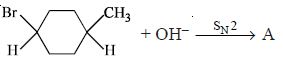
(Given data : Molar mass and the molal freezing point depression constant of benzene are $78 g mol ^{-1}$ and $5.12 K kg mol ^{-1}$, respectively)