MCQ
The electronic configuration of four elements are given in brackets$L\,\left( {1{s^2},\,\,2{s^2}2{p^1}} \right);\,\,M\,\left( {1{s^2},\,\,2{s^2}\,2{p^5}} \right)$

$Q\,\left( {1{s^2},\,\,2{s^2}\,2{p^6},\,\,3{s^1}} \right);\,\,R\,\left( {1{s^2},\,\,2{s^2}\,2{p^2}} \right)$The element that would most readily form a diatomic molecule is

  • A
    $Q$
  • $M$
  • C
    $R$
  • D
    $L$

Answer

Correct option: B.
$M$
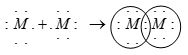
(b) Non-metals readily form diatomic molecules by sharing of electrons. Element $M\,(1{s^2}\,2{s^2}\,2{p^5})$ has seven electrons in its valence shell and thus needs one more electron to complete its octet. Therefore, two atoms share one electron each to form a diatomic molecule $({M_2})$

Need a full question paper?

Generate a complete, print-ready paper with questions like this in minutes — across 16+ boards, with answer keys.

Start Generating Free

Similar questions

In the reaction product $D$ is $\begin{array}{*{20}{c}}
  {C{H_2}} \\ 
  {||\,\,\,\,\,\,\,\,} \\ 
  {C{H_2}} 
\end{array}$ $\xrightarrow{{B{r_2}/CC{l_4}}}A\xrightarrow{{KCN}}B\xrightarrow{{{H_3}{O^ + }}}C\xrightarrow{\Delta }D$
On introducing a catalyst at $500\,K,$ the rate constant of a first order reaction increases $2.718$ times. If the activation energy in the presence of a catalyst is $4.15\, kJ\, mol^{-1}.$ Then what will be $E_a$ in absence of catalyst (value of $e = 2.718$ ) ......... $kJ$
The $IUPAC$ name of  (figure) is
Three faradays electricity was passed through an aqueous solution of iron $ (II)$  bromide. The weight of iron metal (at. wt. $= 56$) deposited at the cathode (in gm) is
Which of the following reagent can be used to separate $AgCl$ and $Agl$ ?
Which molecule have triagonal bipyramidal geometry
In which orbit of the Bohr model of the hydrogen atom is the speed of electron maximum
In the given reaction :

 $\begin{array}{*{20}{c}}
  {{C_6}{H_5} - C - H} \\ 
  {\,\,\,\,\,\,\,\,\,\,||} \\ 
  {\,\,\,\,\,\,\,\,\,\,\,\,O} 
\end{array}\xrightarrow{{N{H_2}OH/{H^ \oplus }}}[X]$

$[X] $ will be :

A zwitter ion is
Match the organic compounds in column $-I$ with the Lassaigne's test results in column $-II$ appropriately
Column $-I$ Column $-II$
$(A)$ Aniline $(i)$ Red colour with $FeCl_3$
$(B)$ Benzene sulfonic acid $(ii)$ Violet colour with sodium nitroprusside
$(C)$ Thiourea $(iii)$ Blue colour with hot and acidic solution of $FeSO_ 4$