MCQ
The electronic configuration of four elements are given in brackets$L\,\left( {1{s^2},\,\,2{s^2}2{p^1}} \right);\,\,M\,\left( {1{s^2},\,\,2{s^2}\,2{p^5}} \right)$

$Q\,\left( {1{s^2},\,\,2{s^2}\,2{p^6},\,\,3{s^1}} \right);\,\,R\,\left( {1{s^2},\,\,2{s^2}\,2{p^2}} \right)$The element that would most readily form a diatomic molecule is

  • A
    $Q$
  • $M$
  • C
    $R$
  • D
    $L$

Answer

Correct option: B.
$M$
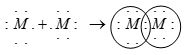
(b) Non-metals readily form diatomic molecules by sharing of electrons. Element $M\,(1{s^2}\,2{s^2}\,2{p^5})$ has seven electrons in its valence shell and thus needs one more electron to complete its octet. Therefore, two atoms share one electron each to form a diatomic molecule $({M_2})$

Need a full question paper?

Generate a complete, print-ready paper with questions like this in minutes — across 16+ boards, with answer keys.

Start Generating Free