MCQ
The electronic transition in atom produces
  • A
    ultra violet light
  • visible light
  • C
    infra-red rays
  • D
    microwaves

Answer

Correct option: B.
visible light
visible light

Need a full question paper?

Generate a complete, print-ready paper with questions like this in minutes — across 16+ boards, with answer keys.

Start Generating Free

Similar questions

A body is thrown vertically upwards. Which one of the following graphs correctly represent the velocity vs time?
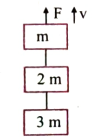
Three blocks with masses m, 2m and 3m are connected by strings, as shown in the figure. After an upward force F is applied on block m, the masses move upward at constant speed v. What is the net force on the block of mass 2 m? (g is the acceleration due to gravity)
Image
Two metal wires ' $P$ ' and ' $Q$ ' of same length and material are stretched by same load. Their masses are in the ratio $m_1: m_2$. The ratio of elongations of wire ' $P$ ' to that of ' $Q$ ' is
Three vectors $\vec{A}, \vec{B}$ and $\vec{C}$ satisfy the relation $\vec{A} \cdot \vec{B}=0$ and $\vec{A} \cdot \vec{C}=0$, then $\vec{A}$ is parallel to
A uniform rod of mass 2m is held horizontal by two sturdy, practically inextensible vertical strings tied at its ends. A boy of mass 3m hangs himself at one third length of the rod. Ratio of the tension in the string close to the boy to that in the other string is
The length of second's hand in a watch is 1 cm. The change in velocity of its tip in 15 seconds is
A particles is performing a uniform circular motion along circle of radius ' $R$ '. In half the period of revolution, its displacement and distance covered are respectively
The internal resistance of a cell of emf 2 V is 0.1 Ω, it is connected to a resistance of 0.9 Ω. The voltage across the cell will be
A metal rod of length $L$ and cross-sectional area $A$ is heated through $T^{\circ} C$. What is the force required to prevent the expansion of the rod lengthwise?