MCQ
The electrons cannot exist inside the nucleus because:
  • A
    De-Broglie wavelength associated with electron in $\beta - \text{decay}$ is much less than the size of nucleus.
  • B
    De-Broglie wavelength associated with electron in $\beta - \text{decay}$ is much greater than the size of nucleus.
  • C
    De-Broglie wavelength associated with electron in $\beta - \text{decay}$ is equal to the size of nucleus.
  • D
    Negative charge cannot exist in the nucleus.

Answer

  1. De-Broglie wavelength associated with electron in $\beta - \text{decay}$ is much greater than the size of nucleus.

Need a full question paper?

Generate a complete, print-ready paper with questions like this in minutes — across 16+ boards, with answer keys.

Start Generating Free

Similar questions

With increase in frequency of an A.C. supply, the inductive reactance.

The phenomena of total internal reflection is seen when angle of incidence is

(a) 90°     

(b) Greater than critical angle

(c) Equal to critical angle

(d) 0°       

The electric field inside a spherical shell of uniform surface charge density is:

The magnitude of the earth’s magnetic field at a place is  and the angle of dip is δ. A horizontal conductor of length l lying along the magnetic north-south moves eastwards with a velocity v. The emf induced across the conductor is

(a) Zero

(b)

(c)   

(d)  

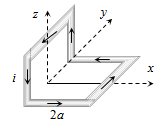
A non-planar loop of conducting wire carrying a current I is placed as shown in the figure. Each of the straight sections of the loop is of length 2a. The magnetic field due to this loop at the point P (a,0,a) points in the direction

(a)  

(b)  

(c)  

(d)  

A radioactive sample is a-emitter with half life 138.6 days is observed by a student to have 2000 disintegration/sec. The number of radioactive nuclei for given activity are

(a) 3.45 × 10¹⁰

(b) 1 × 10¹⁰

(c) 3.45 × 10¹⁵

(d) 2.75 × 10¹¹

In the CB mode of a transistor, when the collector voltage is changed by 0.5 volt. The collector current changes by 0.05 mA. The output resistance will be

(a) 10 kW  

(b) 20 kW

(c) 5 kW  

(d) 2.5 kW

In a purely inductive circuit, the current:

A magnetic field

(a) Always exerts a force on a charged particle

(b) Never exerts a force on a charged particle

(c) Exerts a force, if the charged particle is moving across the magnetic field lines

(d) Exerts a force, if the charged particle is moving along the magnetic field lines

A long straight horizontal cable carries a current of 2.5 A in the direction 10° south of west to 10° north of east. The magnetic meridian of the place happens to be 10° west of the geographic meridian. The earth’s magnetic field at the location is 0.33 Gauss, and the angle of dip is zero. Locate the line of neutral points. (Ignore the thickness of the cable).