- Aindependent of the distance between the plates
- Binversely proportional to the distance between the plates
- Cproportional to the square root of the distance between the plates
- Dlinearly proportional to the distance between the plates
Generate a complete, print-ready paper with questions like this in minutes — across 16+ boards, with answer keys.
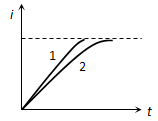
When a certain circuit consisting of a constant e.m.f. E an inductance L and a resistance R is closed, the current in, it increases with time according to curve 1. After one parameter (E, L or R) is changed, the increase in current follows curve 2 when the circuit is closed second time. Which parameter was changed and in what direction

|
(a) L is increased |
(b) L is decreased |
(c) R is increased |
(d) R is decreased |
A cylindrical conductor has uniform cross-section. Resistivity of its material increase linearly from left end to right end. If a constant current is flowing through it and at a section distance x from left end, magnitude of electric field intensity is E, which of the following graphs is correct
|
(a) |
(b) |
(c) |
(d) |
A capacitor having capacitance C is charged to a voltage V. It is then removed and connected in parallel with another identical capacitor which is uncharged. The new charge on each capacitor is now
|
(a) CV |
(b) CV / 2 |
(c) 2 CV |
(d) CV / 4 |
An electron (charge = 1.6
) is accelerated through a potential of 100,000 V. The energy acquired by the electron is
|
(a) 1.6 |
(b) 1.6 |
(c) 0.53 |
(d) 1.6 |
If are the lengths of the emitter, base and collector of a transistor then
|
(a) |
(b) |
(c) |
(d) |
$\frac{1}{\text{v}}-\frac{1}{\text{u}}=\frac{1}{\text{uf}}$
$\frac{1}{\text{v}^2}-\frac{1}{\text{u}}=\frac{1}{\text{f}}$
$\frac{1}{\text{v}-\text{t}}-\frac{1}{\text{u}+\text{t}}=\frac{1}{\text{f}}$
$\frac{1}{\text{v}}-\frac{1}{\text{u}}+\frac{\text{t}}{\text{uv}}=\frac{\text{t}}{\text{f}}$