MCQ
The electrostatic potential due to an electric dipole is directly proportional to:
  • A
    $\frac{1}{\text{r}}$
  • $\frac{1}{\text{r}^2}$
  • C
    $\text{r}$
  • D
    $\text{r}^2$

Answer

Correct option: B.
$\frac{1}{\text{r}^2}$

Need a full question paper?

Generate a complete, print-ready paper with questions like this in minutes — across 16+ boards, with answer keys.
Start Generating Free

Similar questions

A half ring of radius $R$ has a charge of $\lambda$ per unit length. The electric force on $1\, C$ charged placed at the centre is
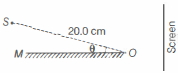
A monochromatic light source $S$ of wavelength $440 \,nm$ is placed slightly above a plane mirror $M$ as shown below. Image of $S$ in $M$ can be used as a virtual source to produce interference fringes on the screen. The distance of source $S$ from $O$ is $20.0 \,cm$ and the distance of screen from $O$ is $100.0 \,cm$ (figure is not to scale). If the angle $\theta=0.50 \times 10^{-3}$ radians, then the width of the interference fringes observed on the screen is ............... $mm$
At what temperature will the resistance of a copper wire become three times its value at $0\,^oC$  ................. $^oC$ (Temperature coefficient of resistance for copper = $4 × 10^{-3} \,per\, \,^oC$ )
Eight small drops, each of radius r and having same charge q are combined to form a big drop. The ratio between the potentials of the bigger drop and the smaller drop is
In which of the following fields cathode rays show minimum deflection?
Light of two different frequencies whose photons have energies 1eV and 2.5eV respectively, successively illuminates a metal of work function 0.5eV. The ratio of maximum kinetic energy of the emitted electron will be
Electric lines of force about negative point charge are
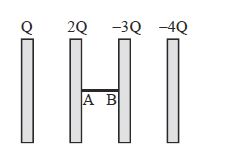
Four very large metal plates are given the charges as shown in figure. The middle two are then connected through a wire. Find the charge that will flow through the wire
When an object is placed at a distance of $25\; cm$ from a mirror, the magnification is $m _1$. The object is moved $15 \;cm$ away with respect to the earlier position, magnification becomes $m _2$, If $\frac{ m _1}{ m _2}=4$, the focal length of the mirror is
Resolving power of a microscope depends upon