The ends of stretched wire of length $L$ are fixed at $x\, = 0$ and $x \,= L$. In one experiment, the displacement of the wire is ${y_1} = A\sin\, \left( {\pi x/L} \right)\sin \,\omega t$ and energy is $E_1$. and in another experiment its displacement is ${y_2} = A\sin \,\left( {2\pi x/L} \right)\sin 2\omega t$ and energy is $E_2$, Then
Medium

 $(Amplitude)^2\, (Frequency)^2$ Amplitude is same in both the cases, but frequency $2\omega$ in the second case is two times the frequency $(\omega)$ in the first case, Hence $E_2\, = 4E_1$
Download our appand get started for free
Experience the future of education. Simply download our apps or reach out to us for more information. Let's shape the future of learning together!No signup needed.*
Similar Questions
- 1Assume that the displacement$(s)$ of air is proportional to the pressure difference $(\Delta p)$ created by a sound wave. Displacement$(s)$ further depends on the speed of sound $(v),$ density of air $(\rho)$ and the frequency $(f)$ If $\Delta p \approx 10\, Pa , v \approx 300\, m / s , p \approx 1\, kg / m ^{3}$ and $f \approx 1000 \,Hz$, then $s$ will be the order ofView Solution
(take multiplicative constant to be $1$ )
- 2View SolutionA micro-wave and an ultrasonic sound wave have the same wavelength. Their frequencies are in the ratio (approximately)
- 3$A$ source $S$ of frequency $f_0$ and an observer $O$, moving with speeds $v_1$ and $v_2$ respectively, are movinng away from each other. When they are separated by distance a $(t =0)$, a pulse is emitted by the source. This pulse is received by $O$ at time $t_1$ then $t_1$, is equal toView Solution
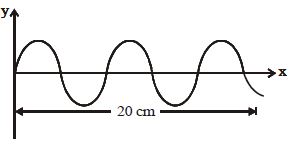
- 4Figure given shows a sinusoidal wave on a string. If the frequency of the wave is $150\, Hz$, what is the wavelength and velocity of the given wave ?View Solution
- 5A tuning fork resonates with a sonometer wire of length $1 \mathrm{~m}$ stretched with a tension of $6 \mathrm{~N}$. When the tension in the wire is changed to $54 \mathrm{~N}$, the same tuning fork produces $12$ beats per second with it. The frequency of the tuning fork is $\mathrm{Hz}$.View Solution
- 6A travelling harmonic wave is represented by the equation $y(x, t) = 10^{-3}\,sin\,(50t + 2x)$, where $x$ and $y$ are in meter and $t$ is in seconds. Which of the following is a correct statement about the wave?View Solution
- 7View SolutionQuality of a musical note depends on
- 8The phase difference between the two particles situated on both the sides of a node is ... $^o$View Solution
- 9A wire having a linear mass density $9.0 \times 10^{-4} \;{kg} / {m}$ is stretched between two rigid supports with a tension of $900\; {N}$. The wire resonates at a frequency of $500\;{Hz}$. The next higher frequency at which the same wire resonates is $550\; {Hz}$. The length of the wire is $...... {m}$View Solution
- 10The vibrations of a string of length $60\, cm$ fixed at both the ends are represented by the equation $y = 2\,\sin \,\left( {\frac{{4\pi x}}{{15}}} \right)\,\cos \,\left( {96\pi t} \right)$ where $x$ and $y$ are in $cm$. The maximum number of loops that can be formed in it isView Solution