The energy density $u$ is plotted against the distance $r$ from the centre of a spherical charge distribution on a $log$-$log$ scale. The slope of obtianed straight line is :
Diffcult


Download our appand get started for free
Experience the future of education. Simply download our apps or reach out to us for more information. Let's shape the future of learning together!No signup needed.*
Similar Questions
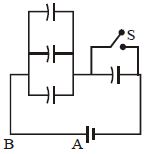
- 1Four capacitors of capacitance $10\,mF$ and a battery of $200\,V$ are arranged as shown. How much charge will flow through $AB$ after the switch $S$ is closed .....$\mu C$View Solution
- 2Three point charges $q, q$ and $-2 q$ are placed at the corners of an equilateral triangle of side '$L$'. Calculate work done by extemal force in moving all the charges far apart without accelerationView Solution
- 3A capacitor of capacitance $50 \; pF$ is charged by $100 \; V$ source. It is then connected to another uncharged identical capacitor. Electrostatic energy loss in the process is $\dots \; nJ$.View Solution
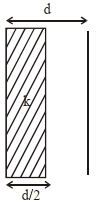
- 4In a parallel plate capacitor set up, the plate area of capacitor is $2 \,m ^{2}$ and the plates are separated by $1\, m$. If the space between the plates are filled with a dielectric material of thickness $0.5\, m$ and area $2\, m ^{2}$ (see $fig.$) the capacitance of the set-up will be $.........\, \varepsilon_{0}$View Solution
(Dielectric constant of the material $=3.2$ ) and (Round off to the Nearest Integer)
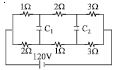
- 5In the circuit shown in figure $C_1 = C_2 = 2$ $\mu F$. Then charge stored inView Solution
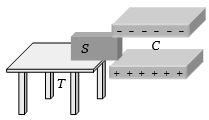
- 6A frictionless dielectric plate $S$ is kept on a frictionless table $T$. A charged parallel plate capacitance $C$ (of which the plates are frictionless) is kept near it. The plate $S$ is between the plates. When the plate $S$ is left between the platesView Solution
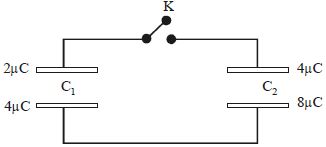
- 7Assertion : Charges are given to plates of two plane parallel plate capacitors $C_1$ and $C_2$ (such that $C_2 = 2C_1$ ) as shown in figure. Then the key $K$ is pressed to complete the circuit. Finally the net charge on upper plate and net charge the circuit. Finally the net charge on upper plate and net charge on lower plate of capacitor $C_1$ is positive.View Solution
Reason : In a parallel plate capacitor both plates always carry equal and opposite charge.
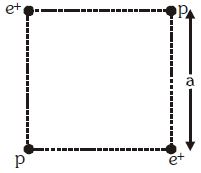
- 8Two positrons $(e^+)$ and two protons $(p)$ are kept on four corners of a square of side $a$ as shown in figure. The mass of proton is much larger than the mass of positron. Let $q$ denotes the charge on the proton as well as the positron then the kinetic energies of one of the positrons and one of the protons respectively after a very long time will be-View Solution
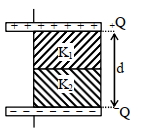
- 9A parallel - plate capacitor with plate area $A$ has separation $d$ between the plates. Two dielectric slabs of dielectric constant ${K}_{1}$ and ${K}_{2}$ of same area $\frac A2$ and thickness $\frac d2$ are inserted in the space between the plates. The capacitance of the capacitor will be given by :View Solution
- 10View SolutionIf the distance between parallel plates of a capacitor is halved and dielectric constant is doubled then the capacitance will become