MCQ
The energy of a system available to do work is called as:
- AGibbs free energy
- BHeat of formation
- CHeinsenberg uncertainty principle
- DHeat of vaporization
Explanation:
The energy of a system available to do work is called as Gibbs free energy.
Heat required to rise one unit mass of a substance by 1 degree Celsius is known as Specific heat.
Heat absorbed or released during production of a substance from elements in their standard states is known as Heat of formation.
Heinsenberg uncertainty principle states that, "It is not possible to determine simultaneously the position and momentum of a moving microsopic particle (electron) with absolute accuracy".
Heat required to vaporize unit mass of a substance without changing its temperature at constant pressure is called Heat of vaporization.
Generate a complete, print-ready paper with questions like this in minutes — across 16+ boards, with answer keys.
(figure) $\xrightarrow[CC{{l}_{4}}]{B{{r}_{2}}}(A)\xrightarrow[(ii)\,NaN{{H}_{2}}]{(i)\,alc.\,KOH}(B)\xrightarrow[(ii)\,C{{H}_{3}}-Cl]{(i)\,NaN{{H}_{2}}}(C)$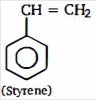
$_H^{Br} > \mathop C\limits_1 = \mathop C\limits_2 < _H^{Br}$ $\xrightarrow[{Catalyst}]{{{H_2}}}Br\mathop {C{H_2}}\limits_3 \mathop {C{H_2}}\limits_4 Br$
$NO_2^ + \to N{O_2} \to NO_2^ - $
Statement $I$: $\mathrm{PF}_5$ and $\mathrm{BrF}_5$ both exhibit $\mathrm{sp}^3 \mathrm{~d}$ hybridisation.
Statement $II$: Both $\mathrm{SF}_6$ and $\left[\mathrm{Co}\left(\mathrm{NH}_3\right)_6\right]^{3+}$ exhibit $\mathrm{sp}^3 \mathrm{~d}^2$ hybridisation.
In the light of the above statements, choose the correct answer from the options given below: