MCQ
The energy of electromagnetic wave in vacuum is given by the relation
  • A
    $\frac{{{E^2}}}{{2{\varepsilon _0}}} + \frac{{{B^2}}}{{2{\mu _0}}}$
  • B
    $\frac{1}{2}{\varepsilon _0}{E^2} + \frac{1}{2}{\mu _0}{B^2}$
  • C
    $\frac{{{E^2} + {B^2}}}{c}$
  • $\frac{1}{2}{\varepsilon _0}{E^2} + \frac{{{B^2}}}{{2{\mu _0}}}$
Answer

Correct option: D.
$\frac{1}{2}{\varepsilon _0}{E^2} + \frac{{{B^2}}}{{2{\mu _0}}}$
d
$\frac{1}{2}{\varepsilon _0}E_0^2$ is electric energy density. $\frac{{{B^2}}}{{2{\mu _0}}}$ is magnetic energy density. So, total energy $ = \frac{1}{2}{\varepsilon _0}E_0^2 + \frac{{B_0^2}}{{2{\mu _0}}}$

Need a full question paper?

Generate a complete, print-ready paper with questions like this in minutes — across 16+ boards, with answer keys.

Start Generating Free

Similar questions

In an insulator, the forbidden energy gap between the valence band and conduction band is of the order of:
Match List $I$ of the nuclear processes with List $II$ containing parent nucleus and one of the end products of each process and then select the correct answer using the codes given below the lists :

List $I$ List $II$
$P.$ $\quad$ Alpha decay  $1.$ $\quad{ }_8^{15} 0 \rightarrow{ }_7^{15} N +\ldots \ldots$.
$Q.$ $\quad$ $\beta^{+}$decay $2.$ $\quad{ }_{92}^{238} U \rightarrow{ }_{90}^{234} Th +\ldots \ldots$.
$R.$ $\quad$Fission $3.$ $\quad{ }_{83}^{185} Bi \rightarrow{ }_{82}^{184} Pb +\ldots \ldots$.
$S.$ $\quad$Proton emission $4.$ $\quad{ }_{94}^{239} Pu \rightarrow{ }_{57}^{140} La +\ldots \ldots$.

Codes: $ \quad \quad P \quad Q \quad R \quad S $ 

The forbidden energy band gap in conductors, semiconductors and insulators are $E{G_1},\,E{G_2}$and $E{G_3}$ respectively. The relation among them is
In nuclear fission the percentage of mass converted into energy is about
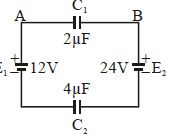
Two capacitors $C_1$ and $C_2$ are connected in a cirucit as shown in figure. The potential difference $(V_A -V_B)$ is.....$V$
Angle of a prism is $30^{\circ}$ and its refractive index is $\sqrt{2}$ and one of the surface is silvered. At what angle of incidence, a ray should be incident on one surface so that after reflection from the silvered surface, it retraces its path
The de Broglie wavelengths of a proton and an $\alpha$ particle are $\lambda$ and $2 \lambda$ respectively. The ratio of the velocities of proton and $\alpha$ particle will be :
A particle of mass $m$ and charge $q$, accelerated by a potential difference $V$ enters a region of a uniform transverse magnetic field $B$. If $d$ is the thickness of the region of $B$, the angle $\theta$ through which the particle deviates from the initial direction on leaving the region is given by
Diffusion current in a $p-n$ junction is greater than the drift current in magnitude:
A series $AC$ circuit containing an inductor $(20\,mH),$ a capacitor $(120\,\mu F)$ and a resistor $(60\, \Omega )$ is driven by an $AC$ source of $24\,V/50\,Hz.$ The energy dissipated in the circuit in $60\,s$ is