MCQ
The energy required to release $ 1$ electron from $H{e^ + }$ is ............ $\mathrm{eV}$
- A$+ 54.4$
- ✓$-13.6$
- C$+ 27.2$
- DCannot be predicted
$E = - \frac{{13.6}}{{{1^2}}} = - 13.6\,eV$.
Generate a complete, print-ready paper with questions like this in minutes — across 16+ boards, with answer keys.
$(A)$ $\mathrm{H}$ and $\mathrm{H}$
$(B)$ $\mathrm{H}$ and $\mathrm{C}_2 \mathrm{H}_5$
$(C)$ $\mathrm{C}_2 \mathrm{H}_5$ and $\mathrm{H}$
$(D)$ $\mathrm{CH}_3$ and $\mathrm{CH}_3$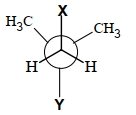
$56\ g$ of nitrogen and $8\ g$ of hydrogen gas are heated in a closed vessel. At equilibrium, $34\ g$ of ammonia are present. The equilibrium number of moles of nitrogen, hydrogen and ammonia are respectively