MCQ
The energy required to remove the electron from a singly ionized Helium atom is $2.2\, times$ the energy required to remove an electron from Helium atom . The total energy required to ionize the Helium atom completely is......$eV$
  • A
    $20$
  • $79$
  • C
    $109$
  • D
    $34$

Answer

Correct option: B.
$79$
b
Energy required to remove e - from singly

ionized helium atom ${ = \frac{{(13.6){Z^2}}}{{{1^2}}} = 54.4\,{\text{eV}}}$

$(\because Z=2)$

Energy required to remove $e^-$ from helium atom $=x\,eV$

According to question, $54.4 \mathrm{eV}=2.2 \mathrm{x} \Rightarrow \mathrm{x}$

$=24.73 \mathrm{eV}$

Therefore, energy required to ionize helium atom $=(54.4+24.73)eV$ $=79.12 \mathrm{eV}$

Need a full question paper?

Generate a complete, print-ready paper with questions like this in minutes — across 16+ boards, with answer keys.

Start Generating Free

Similar questions

A bullet of mass $2\, gm$ is having a charge of $2\,\mu C$. Through what potential difference must it be accelerated, starting from rest, to acquire a speed of $10\,m/s$
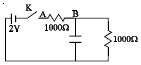
In the circuit shown, when the key $k $ is pressed at time $t = 0$, which of the following statements about current $I$ in the resistor $AB $ is true
An interference pattern was made by using red light. If the red light changes with blue light, the fringes will become
Which of the following is not the unit of self inductance
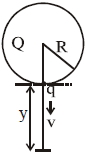
A solid sphere of radius $R$ carries a charge $(Q+q)$ distributed uniformly over its volume. A very small point like piece of it of mass $m$ gets detached from the bottom of the sphere and falls down vertically under gravity. This piece carries charge $q.$ If it acquires a speed $v$ when it has fallen through a vertical height $y$ (see figure), then :

(assume the remaining portion to be spherical).

The plane faces of two identical plano-convex lenses each having focal length of $40 cm$ are pressed against each other to form a usual convex lens. The distance from this lens, at which an object must be placed to obtain a real, inverted image with magnification one is.......$cm$
The total charge of the electric dipole is:
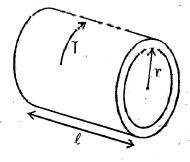
A hollow cylinder has length $l$ , radius $r$ , and thickness $d$ , where $l >> r >> d$ , and is made of a material with resistivity $\rho $ . A timevarying current $I$ flows through the cylinder in the tangential direction. Assume the current is always uniformly distributed along the length of the cylinder. The cylinder is fixed so that it cannot move; assume that there are no externally generated magnetic fields during the time considered for the problems below. Assume current at $t = 0$ to be $I_0$. What is current  $I(t)$ for $t > 0$
A small pin fixed on a table top is viewed from above from a distance of $50\, cm$. By what distance would the pin appear to be raised if it is viewed from the same point through a $15\, cm$ thick glass slab held parallel to the table? Refractive index of glass $= 1.5$ ?......$cm$
Threshold wavelength for sodium is $6 \times 10^{-7} \,m$. Then photoemission occurs for light of wavelength $\lambda$ if