MCQ
The energy stored in a charged capacitor is:
- Aon a positively charged plate
- Bon both positive and negative charged plates
- ✓in the middle region of the plates
- Dat the edge of the capacitor
Generate a complete, print-ready paper with questions like this in minutes — across 16+ boards, with answer keys.
The critical angle between an equilateral prism and air is 45°. If the incident ray is perpendicular to the refracting surface, then
|
(a) After deviation it will emerge from the second refracting surface |
|
(b) It is totally reflected on the second surface and emerges out perpendicularly from third surface in air |
|
(c) It is totally reflected from the second and third refracting surfaces and finally emerges out from the first surface |
|
(d) It is totally reflected from all the three sides of prism and never emerges out |
If λ =10Å, then it corresponds to
|
(a) Infra-red |
(b) Microwave |
(c) Ultra-violet |
(d) X-rays |
The combination of the gates shown in the figure below produces
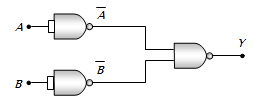
|
(a) NOR gate |
(b) OR gate |
(c) AND gate |
(d) XOR gate |
A biconvex lens forms a real image of an object placed perpendicular to its principal axis. Suppose the radii of curvature of the lens tend to infinity. Then the image would
|
(a) Disappear |
|
(b) Remain as real image still |
|
(c) Be virtual and of the same size as the object |
|
(d) Suffer from aberrations |
A single slit of width 0.20 mm is illuminated with light of wavelength 500 nm. The observing screen is placed 80 cm from the slit. The width of the central bright fringe will be
|
(a) 1 mm |
(b) 2 mm |
(c) 4 mm |
(d) 5 mm |