MCQ
The energy that opposes dissolution of a solvent is
  • A
    Hydration energy
  • B
    Lattice energy
  • C
    Internal energy
  • Bond energy

Answer

Correct option: D.
Bond energy
d
Lattice energy opposes the dissolution of a solvent. Lattice energy is the amount of energy required to dissociate $1\, mole$ of ionic crystal into ions.If the hydrated energy of solid is more than lattice energy, then slid dissolves.

Need a full question paper?

Generate a complete, print-ready paper with questions like this in minutes — across 16+ boards, with answer keys.
Start Generating Free

Similar questions

The $IUPAC$ name of $\begin{matrix}
   C{{H}_{2}}-CH=CH-CHO  \\
   |\,\,\,\,\,\,\,\,\,\,\,\,\,\,\,\,\,\,\,\,\,\,\,\,\,\,\,\,\,\,\,\,\,\,\,\,\,\,\,\,\,\,\,\,\,\,\,\,\,\,\,\,\,\,\,\,\,\,\,\,\,\,\,\,\,  \\
   CHO\,\,\,\,\,\,\,\,\,\,\,\,\,\,\,\,\,\,\,\,\,\,\,\,\,\,\,\,\,\,\,\,\,\,\,\,\,\,\,\,\,\,\,\,\,\,\,\,\,\,\,\,\,\,\,\,  \\
\end{matrix}$ is
Which of the following is not true about $H_2O$ molecule?
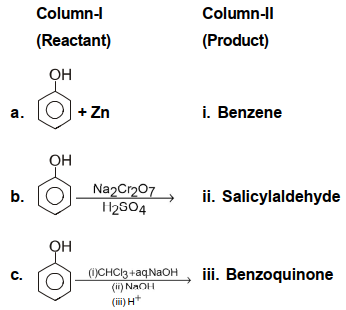
Match the following reactants and reagents given in Column I with the product given in Column II and choose the correct option from the codes given below :
Image
An unknown alkene $(A)$ reacts with $3\, mole$ of $H_2$ gas in presence of  platinum catalyst to form $1$ -isopropyl- $4$ -methyl cyclohexane. When  unknown alkene $(A)$ is ozonized and reduced, following product are obtained 

$\begin{matrix}
   O  \\
   ||  \\
   H-C-H,  \\
\end{matrix}\begin{matrix}
   O\,\,\,\,\,\,\,\,\,\,\,\,\,\,\,\,\,\,\,\,\,\,\,\,\,\,\,O\,\,\,\,\,\,\,O\,\,\,\,  \\
   ||\,\,\,\,\,\,\,\,\,\,\,\,\,\,\,\,\,\,\,\,\,\,\,\,\,\,\,||\,\,\,\,\,\,\,\,\,||\,\,\,\,\,  \\
   H-C-C{{H}_{2}}-C-C-C{{H}_{3}},  \\
\end{matrix}\begin{matrix}
   \,\,\,\,\,O\,\,\,\,\,\,\,\,\,\,\,\,\,\,\,\,\,\,\,\,\,\,\,O  \\
   \,\,\,\,\,\,||\,\,\,\,\,\,\,\,\,\,\,\,\,\,\,\,\,\,\,\,\,\,\,\,\,\,||  \\
   C{{H}_{3}}-C-C{{H}_{2}}-C-H  \\
\end{matrix}$

aalkene $(A)$ will be  ?
For $A + B \longrightarrow C + D$ ; $\Delta H =  - 20\,kJ/mol$ the activation energy of the forward reaction is $85\, kJ\, mole^{-1}$. The activation energy for backward reaction is.....$KJ/mo{l^{ - 1}}$
$1\,mol$ of oxygen gas are heated at constant volume from $20\,^oC$ to $30\,^oC$ . What will be change in the internal energy of gas? Molar heat capacity of oxygen at constant pressure, $ C_P= 7.03\,cal\,mol^{-1}\,K^{-1}$ and $R = 2\,cal\,mol^{-1}\,K^{-1}$ ? .....$cal$
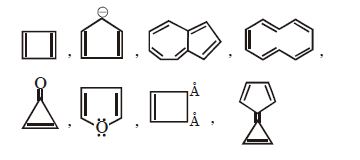
Number of aromatic compounds species in given compounds
The free energy for a reaction having $\Delta H = 31400\,cal;$. $\Delta S = 32\,cal\,{K^{ - 1}}\,mo{l^{ - 1}}$ at ${1000\,^o}C$ is .......$cal$
Going from $K-$shell to $N-$shell in case of $H-$atom :
“$925$ fine silver” means an alloy of :