MCQ
The energy which an ${e^ - }$ acquires when accelerated through a potential difference of $1 \,volt$ is called
  • A
    $1 \,Joule$
  • $1$ $ Electron volt$ 
  • C
    $1\, Erg$
  • D
    $1\, Watt$.

Answer

Correct option: B.
$1$ $ Electron volt$ 
b
(b) this question can be solved by using the formula, $K . E=e V,$ where $e$ is the charge of an electron and $V$ is voltage. so here the kinetic energy would be equal to $\left(1.6 \times 10^{-19}\right) \times 1$ which is $1 e V$

Need a full question paper?

Generate a complete, print-ready paper with questions like this in minutes — across 16+ boards, with answer keys.
Start Generating Free

Similar questions

A person of mass $M$ is, sitting on a swing of length $L$ and swinging with an angular amplitude $\theta_0$. If the person stands up when the swing passes through its lowest point, the work done by him, assuming that his centre of mass moves by a distance $l\, ( l < < L)$, is close to
A cylinder made of perfectly non conducting material closed at both ends is divided into two equal parts by a heat proof piston. Both parts of the cylinder contain the same masses of a gas at a temperature $t_0 = 27^o$ and pressure $P_0 = 1$ atm. Now if the gas in one of the parts is slowly heated to $t = 57^oC$ while the temperature of first part is maintained at $t_0$ the distance moved by the piston from the middle of the cylinder will be.... $cm$ (length of the cylinder $= 84\,\, cm$)
The rate of flow of liquid in a tube of radius $r,$  length $ l,$  whose ends are maintained at a pressure difference $P$  is $V = \frac{{\pi QP\,{r^4}}}{{\eta l}}$ where $\eta $ is coefficient of the viscosity and $Q$ is
The volume of an air bubble becomes three times as it rises from the bottom of a lake to its surface. Assuming atmospheric pressure to be 75cm of mercury and density of water to be $\frac{1}{10}$ of the density of mercury, the depth of the lake is:
Which of the following statements is incorrect for a stationary wave ?
If for two vectors $\overrightarrow A $ and $\overrightarrow B ,\overrightarrow A \times \overrightarrow B = 0,$ the vectors
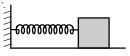
 spring block system is placed on a rough horizontal floor. The block is pulled towards right to give spring some elongation and released. the block will have maximum velocity when
The kinetic energy of one gram molecule of a gas at normal temperature and pressure is $(R = 8.31\,J/mole - K)$
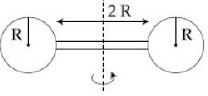
Two identical spherical balls of mass $M$ and radius $R$ each are stuck on two ends of a rod of length $2R$ and mass $M$ (see figure). The moment of inertia of the system about the axis passing perpendicularly through the centre of the rod is
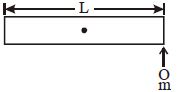
A stick of length $L$ and mass $M$ lies on a frictionless horizontal surface on which it is free to move in any ways. A ball of mass $m$ moving with speed $v$ collides elastically with the stick as shown in the figure. If after the collision the ball comes to rest, then what should be the mass of the ball ?