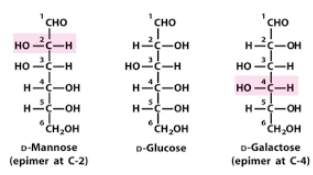
The ‘epimerisation’ involves
Easy


Download our appand get started for free
Experience the future of education. Simply download our apps or reach out to us for more information. Let's shape the future of learning together!No signup needed.*
Similar Questions
- 1The reaction of concentrated sulphuric acid with carbohydrates $\left( C _{12} H _{22} O _{11}\right)$ is an example ofView Solution
- 2For 'invert sugar', the correct statement(s) is(are)View Solution
(Given: specific rotations of ($+$)-sucrose, ($+$)-maltose, $L$-($-$)-glucose anc. $+(+)$-fructose in aqueous solution are $+66^{\circ},+140^{\circ},-52^{\circ}$ and $+92^{\circ}$, respectively)
($A$) 'invert sugar' is prepared by acid catalyzed hydrolysis of maltose
($B$) . 'invert sugar' is an equimolar mixture of $D$-($+$)-glucose and $D$-($-$)-fructose
($C$) specific rotation of 'invert sugar' is $-20^{\circ}$
($D$) on reaction with $\mathrm{Br}_2$ water, 'invert sugar' forms saccharic acid as one of the products
- 3$\alpha - $ Amino acids areView Solution
- 4View SolutionGlucose and fructose are ......................... of each other
- 5View SolutionThe change in optical rotation with time of freshly prepared solutions of sugar is known as
- 6View SolutionDuring the denaturation of proteins, which of these structures will remain intact?
- 7View SolutionFunction of enzymes in the living system is to
- 8View SolutionWhich one is a disaccharide
- 9View SolutionWhich is a reducing sugar
- 10View SolutionWhich of the following is non-reducing sugar?