MCQ
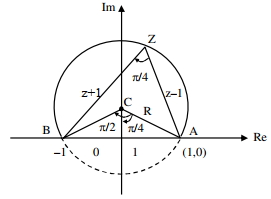
The equation $\arg \left(\frac{\mathrm{z}-1}{\mathrm{z}+1}\right)=\frac{\pi}{4}$ represents a circle with:
  • A
    centre at $(0,-1)$ and radius $\sqrt{2}$
  • centre at $(0,1)$ and radius $\sqrt{2}$
  • C
    centre at $(0,0)$ and radius $\sqrt{2}$
  • D
    centre at $(0,1)$ and radius $2$

Answer

Correct option: B.
centre at $(0,1)$ and radius $\sqrt{2}$
b
In $\triangle \mathrm{OAC}$

$\sin \left(\frac{\pi}{4}\right)=\frac{1}{\mathrm{AC}}$

$\Rightarrow \mathrm{AC}=\sqrt{2}$

Also, $\tan \frac{\pi}{4}=\frac{\mathrm{OA}}{\mathrm{OC}}=\frac{1}{\mathrm{OC}}$

$\Rightarrow \mathrm{OC}=1$

$\therefore$ centre $(0,1) ;$ Radius $=\sqrt{2}$

Need a full question paper?

Generate a complete, print-ready paper with questions like this in minutes — across 16+ boards, with answer keys.

Start Generating Free

Similar questions

Let $\vec{a}, \vec{b}$ and $\overrightarrow{ c }$ be three non-coplanar unit vectors such that the angle between every pair of them is $\frac{\pi}{3}$. If $\vec{a} \times \vec{b}+\vec{b} \times \vec{c}=p \vec{a}+q \vec{b}+r \vec{c}$, where $p, q$ and $r$ are scalars, then the value of $\frac{p^2+2 q^2+r^2}{q^2}$ is
Let $f$ be a real valued continuous function on $[0,1]$ and $f(x)=x+\int\limits_{0}^{1}(x-t) f(t) d t$. Then which of the following points $( x , y )$ lies on the curve $y =f( x )$ ?
Circles ${x^2} + {y^2} - 2x - 4y = 0$ and ${x^2} + {y^2} - 8y - 4 = 0$
Given that$f'(2)=6$ and $f'(1) = 4) = $, then $\mathop {\lim }\limits_{h \to 0} \frac{{f(2h + 2 + {h^2}) - f(2)}}{{f(h - {h^2} + 1) - f(1)}} = $
If the mean deviation about the mean of the numbers $1,2,3, \ldots ., n$, where $n$ is odd, is $\frac{5(n+1)}{n}$, then $n$ is equal to
If $a, b, c, d$ and $p$ are distinct real numbers such that $(a^2 + b^2 + c^2)\,p^2 -2p\, (ab + bc + cd) + (b^2 + c^2 + d^2)  \le 0$, then
A bag contains $a$ white and $b$ black balls. Two players $A$ and $B$ alternately draw a ball from the bag replacing the ball each time after the draw till one of them draws a white ball and wins the game. $A$ begins the game. If the probability of $A$ winning the game is three times that of $B$, then the ratio $a : b$ is
The set of all $\alpha$, for which the vector $\vec{a}=\alpha t \hat{i}+6 \hat{j}-3 \hat{k} \quad$ and $\quad \vec{b}=t \hat{i}-2 \hat{j}-2 \alpha t \hat{k} \quad$ are inclined at an obtuse angle for all $t \in \mathbb{R}$ is :
The sum of the solutions of the equation $\left| {\sqrt x  - 2} \right| + \sqrt x \left( {\sqrt x  - 4} \right) + 2 = 0\left( {x > 0} \right)$ is equal to
If $\int\limits_0^2 {} \,375 \,x^5 (1 + x^2)^{-4}\, dx = 2^n$ then the value of $n$ is :