MCQ
The equation E = pc is valid:
- AFor an electron as well as for a photon.
- BFor an electron but not for a photon.
- CFor a photon but not for an electron.
- DNeither for an electron nor for a photon.
Explanation:
The equation E = pc is valid for a particle with zero rest mass. The rest mass of a photon is zero, but the rest mass of an electron is not zero. So, the equation will be valid for photon, and not electron.
Generate a complete, print-ready paper with questions like this in minutes — across 16+ boards, with answer keys.
What will be the angle of diffracting for the first minimum due to Fraunhoffer diffraction with sources of light of wave length 550 nm and slit of width 0.55 mm
|
(a) 0.001 rad |
(b) 0.01 rad |
(c) 1 rad |
(d) 0.1 rad |
A piece of cloud having area 25  and electric potential of
  volts. If the height of cloud is 0.75 km, then energy of electric field between earth and cloud will be
|
(a) 250 J |
(b) 750 J |
(c) 1225 J |
(d) 1475 J |
Choose the correct option:
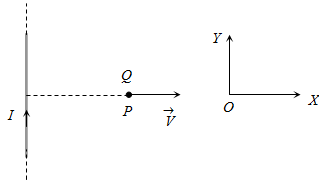
A very long straight wire carries a current I. At the instant when a charge +Q at point P has velocity  , as shown, the force on the charge is
|
(a) Opposite to OX |
(b) Along OX |
(c) Opposite to OY |
(d) Along OY |
For the diode, the characteristic curves are given at different temperature. The relation between the temperatures is

(a) 
|
(b) 
|
(c) 
|
(d) None of the above |