Question
The equation for the vibration of a string, fixed at both ends vibrating in its third harmonic, is given by

$\text{y}=(0.4\text{cm})\sin\big[(0.314\text{cm}^{-1})\text{x}\big]\cos\big[(600\pi\text{s}^{-1})\text{t}\big]$

  1. What is the frequency of vibration?
  2. What are the positions of the nodes?
  3. What is the length of the string?
  4. What is the wavelength and the speed of two travelling waves that can interfere to give this vibration ?
Answer

The stationary wave equation is given by

$\text{y}(0.4\text{cm})\sin\big[(0.314\text{cm}^{-1})\text{x}\big]\cos\big[(600\pi\text{s}^{-1})\text{t}\big]$

  1. $\omega=600\pi\Rightarrow2\pi\text{f}=600\pi\Rightarrow\text{f}=300\text{Hz}$

Wavelength,, $\lambda=\frac{2\pi}{0.314}=\frac{(2\times3.14)}{0.314}=20\text{cm}$

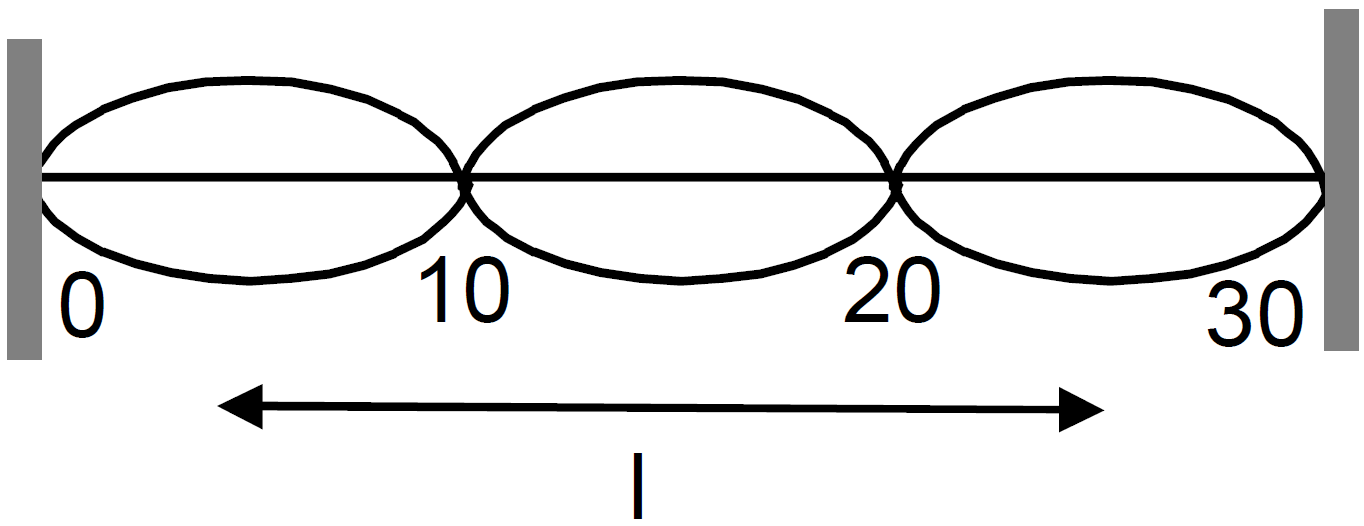
  1. Therefore nodes are located at, $0,\ 10\text{cm},\ 20\text{cm},\ 30\text{cm}$

  2. Length of the string $=\frac{3\lambda}{2}=3\times\frac{20}{2}=30\text{cm}$

  3. $\text{y}=0.4\sin(0.314\text{x})\cos(600\pi\text{t})$

$\Rightarrow0.4\sin\Big\{\big(\frac{\pi}{10}\big)\text{x}\Big\}\cos(600\pi\text{t})$

since $\lambda$ and v are the wavelength and velocity of the waves that interfere to give this vibration $\lambda=20\text{cm}$

$\text{v}=\frac{\omega}{\text{k}}=6000\text{cm/sec}=60\text{m/s}$

Need a full question paper?

Generate a complete, print-ready paper with questions like this in minutes — across 16+ boards, with answer keys.

Start Generating Free

Similar questions

Show dimensionally that the frequency n of transverse waves in a string of length / and mass, per unit length z under a tension T is given by n = $\frac{\text{K}}{l}\sqrt{\frac{\text{T}}{\text{m}}}.$
A SONAR (sound navigation and ranging) uses ultrasonic waves to detect and locate objects under water. In a submarine equipped with a SONAR, the time delay between generation of a probe wave and the reception of its echo after reflection from an enemy submarine is found to be 77.0s. What is the distance of the enemy submarine? (Speed of sound in water = 1450m s–1).
Two particles of masses m1 and m2 are joined by a light rigid rod of length r. The system rotates at an angular speed co about an axis through the centre of mass of the system and perpendicular to the rod. Show that the angular momentum of the system is $\text{L}=\mu\text{r}^2\omega$ where $\mu$ is the reduced mass of the system defined as $\mu=\frac{\text{m}_1\text{m}_2}{\text{m}_1+\text{m}_2}.$
Aman stands on a weighing machine placed on a horizontal platform. The machine reads 50kg. By means of a suitable mechanism, the platform is made to execute harmonic vibrations up and down with a frequency of two vibrations per second. What will be the effect on the reading of the weighing machine? The amplitude of vibrations of platform is 5cm. Take, g = 10ms-2.
A wheel starting from rest is uniformly accelerated at 4 rad/-s2 for 10 seconds.It is allowed to rotate uniformly for the next 10 seconds and is finally brought to rest in the next 10 seconds. Find the total angle rotated by the wheel.
State work energy theorem for rotational motion.
At what temperature the mean speed of the molecules of hydrogen gas equals the escape epeed from the earth?
A car of mass 1000kg travels up an incline of 1 in 25 at a constant velocity of 50km/ h. What power does the car engine have to develop if there is a resistive force of 300 N opposing the motion?
A wheel of moment of inertia 0.500kg-m2 and radius 20.0cm is rotating about its axis at an angular speed of 20.0rad/s. It picks up a stationary particle of mass 200g at its edge. Find the new angular speed of the wheel.
In one-dimensional elastic collision of equal masses, the velocities are interchanged. Can velocities in a onedimensional collision be interchanged if the masses are not equal?