MCQ
The equation $\left| {z - i} \right| = \left| {z - 1} \right|,i = \sqrt { - 1} $, represents
  • A
    a circle of radius $\frac{1}{2}$
  • the line through the origin with slope $1$
  • C
    a circle of radius $1$
  • D
    the line through the origin with slope $-1$

Answer

Correct option: B.
the line through the origin with slope $1$
b
$\left| {z - i} \right| = \left| {z - 1} \right|$

gives $y = x$

Need a full question paper?

Generate a complete, print-ready paper with questions like this in minutes — across 16+ boards, with answer keys.
Start Generating Free

Similar questions

Let a variable line of slope $m>0$ passing through the point $(4,-9)$ intersect the coordinate axes at the points $A$ and $B$. the minimum value of the sum of the distances of $\mathrm{A}$ and $\mathrm{B}$ from the origin is
A sequence is called ___________________ if $a_{n+1}=a_n \times r$.
In G.P. 4, 8, 16, 32, ………… find the sum up to 5th term.
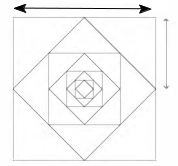
Let $S_1$ be the sum of areas of the squares whose sides are parallel to coordinate axes. Let $S_2$ be the sum of areas of the slanted squares as shown in the figure. Then, $\frac{S_1}{S_2}$ is equal to
Let $i=\sqrt{-1}$. If $\frac{(-1+i \sqrt{3})^{21}}{(1-i)^{24}}+\frac{(1+i \sqrt{3})^{21}}{(1+i)^{24}}=k$, and $n =[| k |]$ be the greatest integral part of $| k |$. Then $\sum_{ j =0}^{ n +5}( j +5)^{2}-\sum_{ j =0}^{ n +5}( j +5)$ is equal to ........ .
Suppose $a_2, a_3, a_4, a_5, a_6, a_7$ are integers such that $\frac{5}{7}=\frac{a_2}{2 !}+\frac{a_3}{3 !}+\frac{a_4}{4 !}+\frac{a_5}{5 !}+\frac{a_6}{6 !}+\frac{a_7}{7 !}$

where $0 \leq a_j < j$ for $j=2,3,4,5,6,7$. The sum of $a_2+a_3+a_4+a_5+a_6+a_7$ is

The mean of a set of observation is $\bar x$. If each observation is divided by $\alpha$, $\alpha$ $\neq$ $0$ and then is increased by $10$, then the mean of the new set is
The value of $\tan\text{x}\tan\Big(\frac{\pi}{3}-\text{x}\Big)\tan\Big(\frac{\pi}{3}+\text{x}\Big)$ is:
Find the distance between (12, 3, 4) and (4, 5, 2):
$\mathop {lim}\limits_{n \to \infty } \cos \left( {\pi \sqrt {{n^2} + n} } \right)$ , where $n \in I$ , is