MCQ
The equation $\left(P+\frac{a}{V^2}\right)(V-b)$ constant. The units of $a$ are
  • A
    Dyne $\times cm ^5$
  • Dyne $\times cm ^4$
  • C
    Dyne $/ cm ^3$
  • D
    Dyne/cm

Answer

Correct option: B.
Dyne $\times cm ^4$
(b) Units of $a$ and $P V$ are same and equal to $d y n e \times c m$.

Need a full question paper?

Generate a complete, print-ready paper with questions like this in minutes — across 16+ boards, with answer keys.
Start Generating Free

Similar questions

The velocity of heat radiation in vacuum is
Energy stored in a coil of self inductance $40 \mathrm{mH}$ carrying a steady current of $2\  A$ is
A tuning fork of frequency $340 \mathrm{~Hz}$ is vibrated just above the tube of $120 \mathrm{~cm}$ height. Water is poured slowly in the tube. What is the minimum height of water necessary for the resonance (speed of sound in the air $=340 \mathrm{~m} / \mathrm{sec}$ )
A square loop of side $2\, a ,$ and carrying current I, is kept in $XZ$ plane with its centre at origin. A long wire carrying the same current $I$ is placed parallel to the $z-$axis and passing through the point $(0, b, 0),(b>>a)$. The magnitude of the torque on the loop about $z-$axis is given by:
If a magnet of pole strength $m$ is divided into four parts such that the length and width of each part is half that of initial one, then the pole strength of each part will be
A bar magnet of magnetic moment $\vec{M}$ is placed in a magnetic field of induction $\vec{B}$. The torque exerted on it is
To increase both the resolving power and magnifying power of a telescope
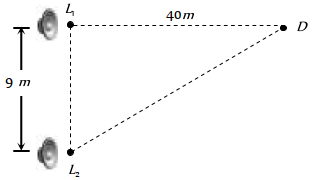
Two loudspeakers $L$ and $L$ driven by a common oscillator and amplifier, are arranged as shown. The frequency of the oscillator is gradually increased from zero and the detector at $D$ records a series of maxima and minima. If the speed of sound is $330 \mathrm{~ms}$ then the frequency at which the first maximum is observed is
Image
Three equal resistors connected in series across a source of e.m.f. together dissipate $10$ watt. If the same resistors are connected in parallel across the same e.m.f., then the power dissipated will be
Sir C.V. Raman was awarded Nobel Prize for his work connected with which of the following phenomenon of radiation