MCQ
The equation of a wave is represented by $y = {10^{ - 4}}\sin \,\left[ {100\,t - \frac{x}{{10}}} \right].$ The velocity of the wave will be .... $m/s$
  • A
    $100$
  • B
    $4$
  • C
    $0$
  • $1000 $

Answer

Correct option: D.
$1000 $
d
(d) $v = \frac{\omega }{k} = \frac{{100}}{{1/10}} = 1000\,m/s$

Need a full question paper?

Generate a complete, print-ready paper with questions like this in minutes — across 16+ boards, with answer keys.
Start Generating Free

Similar questions

A particle is moving with constant speed in a circular path. When the particle turns by an angle $90^{\circ}$, the ratio of instantaneous velocity to its average velocity is $\pi: x \sqrt{2}$. The value of $x$ will be $.........$
A block of mass $m$ rests on a rough inclined plane. The coefficient of friction between  the surface and the block is $\mu$. At what angle of inclination $\theta$ of the plane to  the horizontal will the block just start to slide down the plane?
Ratio of total energy and rotational kinetic energy in the motion of a disc is
When a disc rotates with uniform angular velocity, which of the following is not true?
The general displacement of a simple harmonic oscillator is $x = A \sin \omega t$. Let $T$ be its time period. The slope of its potential energy (U) - time (t) curve will be maximum when $t=\frac{T}{\beta}$. The value of $\beta$ is $.........$
A particle is executing $SHM$ about $y=0$ along $y$-axis. Its position at an instant is given by $y=(7 \,m )$ sin( $\pi f)$. Its average velocity for a time interval $0$ to $0.5 \,s$ is ........... $m / s$
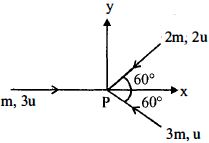
Three masses $m,\,2\,m$ and $3\,m$ are moving in $x-y$ plane with speed $3\,u,\,2\,u\,$ and $u$ respectively as shown in figure. The three masses collide at the same point at $P$ and stick together. The velocity of resulting mass will be
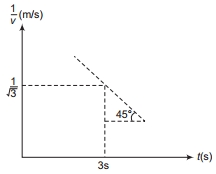
The diagram shows the variation of $1 / v$ (where, $v$ is velocity of the particle) with respect to time. At time $t=3\,s$ using the details given in the graph, the instantaneous acceleration will be equal to $...........m/s^{2}$
The average kinetic energy of a cup doing simple harmonig motion will be :
A particle moves in a region having a uniform magnetic field and a parallel, uniform electric field. At some instant, the velocity of the particle is perpendicular to the field direction. The path of the particle will be: