MCQ
The equation $\overrightarrow {\phi \,} (x,\,t) = \overrightarrow {j\,} \sin \,\left( {\frac{{2\pi }}{\lambda }v\,t} \right)\cos \,\left( {\frac{{2\pi }}{\lambda }x} \right)$ represents
  • A
    Transverse progressive wave
  • B
    Longitudinal progressive wave
  • C
    Longitudinal stationary wave
  • Transverse stationary wave

Answer

Correct option: D.
Transverse stationary wave
d
Let's first find if the given wave equation is stationary or progressive. If we can define certain points for which the amplitude of the wave will always be zero, i.e if the wave has nodal points, then the wave will be considered as stationary. If we put $x =\frac{ n \lambda}{4}$, then the cosine component of the wave becomes zero at, $n =$ $1,2,3,4 \ldots$. So, we can conclude that that their are points in the wave where the amplitude always remains zero as it doesn't depend on time.

Hence, the wave is stationary.

Looking at the equation we see that the wave has an $x$ component. Which means that the wave is propagating in $x$-direction. The amplitude of the wave is $\vec{j}$, which means that the vibration of the wave is in y-direction. We, conclude that the direction of vibration is perpendicular to the direction of propagation. This is the characteristic of a transverse wave, and hence the wave is transverse.

The correct answer is option $(D)$ i.e the wave is transverse and stationary.

Need a full question paper?

Generate a complete, print-ready paper with questions like this in minutes — across 16+ boards, with answer keys.

Start Generating Free

Similar questions

The linear velocity of a rotating body is given by $\overrightarrow v = \overrightarrow \omega \times \overrightarrow r ,$where $\overrightarrow \omega $ is the angular velocity and $\overrightarrow r $ is the radius vector. The angular velocity of a body is $\overrightarrow \omega = \hat i - 2\hat j + 2\hat k$ and the radius vector $\overrightarrow r = 4\hat j - 3\hat k,$ then $|\overrightarrow v |$ is
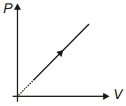
During the thermodynamic process shown in figure for an ideal gas
A force on an object of mass $100\, g$ is $(10 \hat{i}+5 \hat{j}) N$. The position of that object at $t=$ $2 s$ is $(a \hat{i}+b \hat{j}) m$ after starting from rest. The value of $\frac{a}{b}$ will be..........
The pressure inside a small air bubble of radius $0.1\, mm$ situated just below the surface of water will be equal to   [Take surface tension of water $70 \times {10^{ - 3}}N{m^{ - 1}}$ and atmospheric pressure = $1.013 \times {10^5}N{m^{ - 2}}$]
The equation of a wave travelling on a string is $y = 4\sin \frac{\pi }{2}\left( {8t - \frac{x}{8}} \right)$. If $x$ and $y$ are in $cm,$ then velocity of wave is
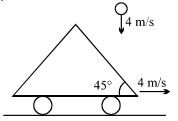
A small ball falling vertically downward with constant velocity $4m/s$ strikes elastically $a$ massive inclined cart moving with velocity $4m/s$ horizontally as shown. The velocity of the rebound of the ball is
The average degree of freedom per molecule of a gas is $6.$ The gas performs $25 \,J$ work, while expanding at constant pressure. The heat absorbed by the gas is ...... $J$
Consider earth to be a homogeneous sphere. Scientist $A$ goes deep down in a mine and scientist $B$ goes high up in a balloon. The value of $g$ measured by
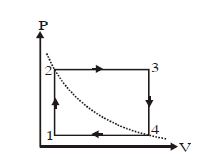
One mole of an ideal gas undergoes a cyclic process, consisting of two isochores and two isobars. Temperature at $1$ and $3$ equal to $T_1$ and $T_3$ respectively. The work done by the gas over the cycle, if the point $2$ and $4$ lie on the same isotherm
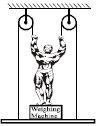
A man uses two pulleys to raise himself with an acceleration $2\,m/s^2$, as in figure. Man stands on a light weighing machine fitted on horizontal platform. Determine the  reading of weighing machine. Mass of man $= 75\, kg,$ mass of platform $= 25\, kg.$  ............ $N$