MCQ
The equation $\rightarrow ∑e = ∑IR$ is applicable to which law?
  • Kirchhoff’s second law.
  • B
    Kirchhoff’s junction rule.
  • C
    Kirchhoff’s third law.
  • D
    Newton’s Law.

Answer

Correct option: A.
Kirchhoff’s second law.

The equation $\rightarrow ∑e = ∑IR$ is applicable to Kirchhoff’s second law. This law is also known as Kirchhoff’s loop rule. This expression tells us that in a closed loop, the algebraic sum of the emfs is equal to the algebraic sum of the products of the resistance and currents flowing through them.

Need a full question paper?

Generate a complete, print-ready paper with questions like this in minutes — across 16+ boards, with answer keys.

Start Generating Free

Similar questions

In an $AC$ generator, a coil with $N$ turns, all of the same area $A$ and total resistance $R$, rotates with frequency $\omega $ in a magnetic field $B$. The maximum value of $emf$ generated in the coil is
Three capacitors of capacitance $1\ \mu F$, $2 \ \mu F$ and $3\ \mu F$ are connected in series and a potential difference of $11 V$ is applied across the combination. Then, the potential difference across the plates of $1\  \mu F$ capacitor is......$V$
When a charged particles moves in a uniform magnetic field in a direction perpendicular to the field, then the path of the particle will be:
Two wires with resistances $R$ and $2R$ are connected in parallel, the ratio of heat generated in $2R$ and $R$ is
Large transformers, when used for some time, become hot and are cooled by circulating oil. The heating of transformer is due to
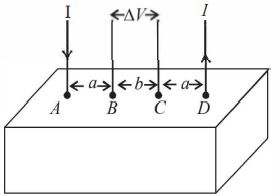
Consider a block of conducting material ofresistivity '$\rho$' shown in the figure. Current '$I$' enters at '$A$' and leaves from '$D$'. We apply superp osition principle to find voltage '$\Delta  V$ ' developed between '$B$' and '$C$'. The calculation is done in the following steps:
$(i)$ Take current '$I$' entering from '$A$' and assume it to spread over a hemispherical surface in the block.
$(ii)$ Calculatefield $E(r)$ at distance '$r$' from $A$ by using Ohm's law $E = \rho  j$, where j is the current per unit area at '$r$'.
(iii) From the '$r$' dependence of $E(r)$, obtain the potential $V(r)$ at $r$.
(iv) Repeat $(i), (ii)$ and $(iii)$ for current '$I$' leaving '$D$' and superpose results for '$A$' and '$D$'.

$\Delta V$ measured between $B$ and $C$ is
The Davisson-Germer experiment that first demonstrated the wave nature of matter used electron accelerated to $54\  V$. Determine the wavelength of the electrons in the Davisson- Germer experiment .................. $\mathop {\rm{A}}\limits^o $
According to Einstein's interpretation of the photoelectric effect, the maximum $K.E.$ of photoelectrons depends on $( h -W)$ where is the frequency of incident radiation and $W$ is the work function. For three different metals graph plotted between maximum $K/E.$ and the frequency of incident radiations. The three graphs obtained:
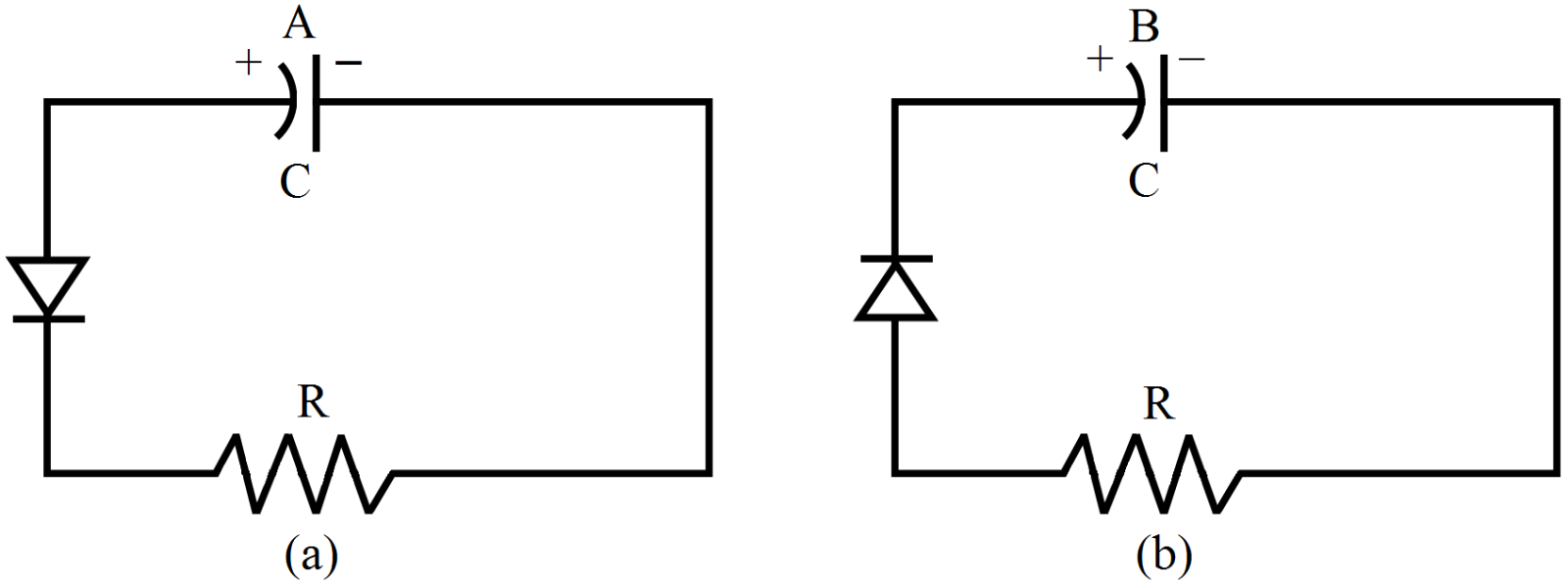
Two identical capacitors A and B are charged to the same potential V and are connected in two circuits at t = 0 as shown in figure. The charges on the capahltors at a time t = CR are, respectively:
Two bar magnets having same geometry with magnetic moments $M$ and $2 M$, are firstly placed in such a way that their similar poles are same side then its time period of oscillation is $T_{1}$. Now the polarity of one of the magnet is reversed then time period of oscillation is $T_{2},$ then