MCQ
The equations of the sides $AB$ and $AC$ of a triangle $ABC$ are $(\lambda+1) x +\lambda y =4 \text { and } \lambda x +(1-\lambda) y +\lambda=0$ respectively. Its vertex $A$ is on the $y$-axis and its orthocentre is $(1,2)$. The length of the tangent from the point $C$ to the part of the parabola $y^2=6 x$ in the first quadrant is
  • A
    $\sqrt{6}$
  • $2 \sqrt{2}$
  • C
    $2$
  • D
    $4$

Answer

Correct option: B.
$2 \sqrt{2}$
b
$AB :(\lambda+1) x +\lambda y =4$

$AC : \lambda x +(1-\lambda) y +\lambda=0$

Vertex $A$ is on $y$-axis

$\Rightarrow x=0$

So $y =\frac{4}{\lambda}, y =\frac{\lambda}{\lambda-1}$

$\Rightarrow \frac{4}{\lambda}=\frac{\lambda}{\lambda-1}$

$\Rightarrow \lambda=2$

$AB : 3 x +2 y =4$

$AC : 2 x - y +2=0$

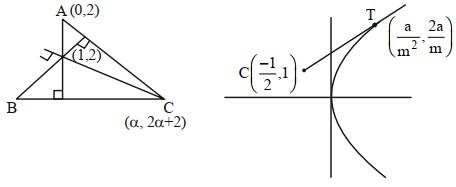
$\Rightarrow A (0,2) \text { Let } C (\alpha, 2 \alpha+2)$

Now (Slope of Altitude through C) $\left(-\frac{3}{2}\right)=-1$

$\left(\frac{2 \alpha}{\alpha-1}\right)\left(-\frac{3}{2}\right)=-1 \Rightarrow \alpha=-\frac{1}{2}$

So $C \left(-\frac{1}{2}, 1\right)$

Let Equation of tangent be $y=m x+\frac{3}{2 m}$

$m ^2+2 m -3=0$

$\Rightarrow m =1,-3$

So tangent which touches in first quadrant at $T$ is

$T \equiv\left(\frac{ a }{ m ^2}, \frac{2 a }{ m }\right)$

$\equiv\left(\frac{3}{2}, 3\right)$

$\Rightarrow CT =\sqrt{4+4}=2 \sqrt{2}$
Need a full question paper?

Generate a complete, print-ready paper with questions like this in minutes — across 16+ boards, with answer keys.

Start Generating Free

Similar questions

If the angles of a quadrilateral are in $A.P.$ whose common difference is ${10^o}$, then the angles of the quadrilateral are
The equation of the circle having the lines $y^2 - 2y + 4x - 2xy = 0$ as its normals $\&$ passing through the point $(2 , 1)$ is :
Two consecutive sides of a parallelogram are $4x + 5y = 0$ and $7x + 2y = 0.$ If the equation to one diagonal is $11x + 7y = 9,$ then the equation of the other diagonal is
Two functions $f \,\& \,g$ have first $ \&$ second derivatives at $x = 0 \& $ satisfy the relations,$f(0) = \frac{2}{{g(0)}}, f ‘ (0) = 2 g ‘ (0) = 4g (0) , g ‘‘ (0) = 5 f ‘‘ (0) = 6 f(0) = 3$ then :
If the system of linear equations $2 x+3 y-z=-2$  ; $x+y+z=4$  ; $x-y+|\lambda| z=4 \lambda-4$  (where $\lambda \in R$), has no solution, then
If the direction ratios of two lines are given by $3lm - 4\,ln + mn = 0$ and $l + 2m + 3n = 0$, then the angle between the lines is
Let $\int_0^x \sqrt{1-\left(y^{\prime}(t)\right)^2} d t=\int_0^x y(t) d t, 0 \leq x \leq 3, y \geq 0$, $\mathrm{y}(0)=0$. Then at $\mathrm{x}=2, \mathrm{y}^{\prime \prime}+\mathrm{y}+1$ is equal to :
The value of the integral $\int \limits_1^{\sqrt{2}+1}\left(\frac{x^2-1}{x^2+1}\right) \frac{1}{\sqrt{1+x^4}} d x$ is
$\frac{{\tan \,\,\left( {x\,\, - \,\,{\textstyle{\pi  \over 2}}} \right)\,\,.\,\,\cos \,\,\left( {{\textstyle{{3\pi } \over 2}}\,\, + \,\,x} \right)\,\, - \,\,{{\sin }^3}\,\left( {{\textstyle{{7\pi } \over 2}}\,\, - \,\,x} \right)}}{{\cos \,\,\left( {x\,\, - \,\,{\textstyle{\pi  \over 2}}} \right)\,\,.\,\,\tan \,\,\left( {{\textstyle{{3\pi } \over 2}}\,\, + \,\,x} \right)}}$ when simplified reduces to :
$\int_{}^{} {\frac{1}{{{x^3}}}{{[\log {x^x}]}^2}\;dx = } $