MCQ
The equations of two waves are given by

$y_{1}=5 \sin 2 \pi(x-v t) \,c m\,$

$y_{2}=3 \sin 2 \pi(x-v t+1.5) \,c m$

These waves are simultaneously passing through a string. The amplitude of the resulting wave is.........$cm$

  • $2$
  • B
    $4$
  • C
    $5.8$
  • D
    $8$

Answer

Correct option: A.
$2$
a
$A_{1}=5 \quad A_{2}=3$

$\Delta \theta=2 \pi(1.5)=3 \pi$

$A_{\text {net }}=\sqrt{A_{1}^{2}+A_{2}^{2}+2 A_{1} A_{2} \cos (3 \pi)}$

$=\left| A _{1}- A _{2}\right|$

$=2 \,cm$

Need a full question paper?

Generate a complete, print-ready paper with questions like this in minutes — across 16+ boards, with answer keys.

Start Generating Free

Similar questions

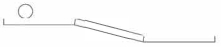
A rigid ball rolls without slipping on a surface shown below: Which one of the following is the most likely representation of the distance travelled by the ball versus time graph?
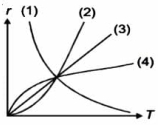
Which graph best represents the variation of radius $r$ of a circular orbit of a satellite against its time period $T$ ?
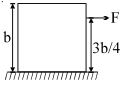
$A$ uniform cube of side $‘b’$ and mass $M$ rest on a rough horizontal table.$ A$ horizontal force $F$ is applied normal to one of the face at $a$ point, at $a$ height $3b/4$ above the base. What should be the coefficient of friction $(\mu )$ between cube and table so that is will tip about an edge before it starts slipping? 
Mars has about $\frac{1}{10}^\text{th}$ as much mass as the earth and half as great a diameter. The acceleration of a falling body on Mars is about:
A ground to ground projectile is at point $A$ at $t=\frac{T}{3}$, is at point $B$ at $t=\frac{5 T}{6}$ and reaches the ground at $t=T$. The difference in heights between points $A$ and $B$ is
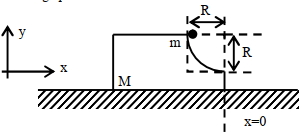
A block of mass $M$ has a circular cut with a frictionless surface as shown. The block rests on the horizontal frictionless surface of a fixed table. Initially the right edge of the block is at $x=0$, in a co-ordinate system fixed to the table. A point mass $m$ is released from rest at the topmost point of the path as shown and it slides down. When the mass loses contact with the block, its position is $\mathrm{x}$ and the velocity is $\mathrm{v}$. At that instant, which of the following options is/are correct?

(image)

$[A]$ The $x$ component of displacement of the center of mass of the block $M$ is : $-\frac{m R}{M+m}$.

[$B$] The position of the point mass is : $x=-\sqrt{2} \frac{\mathrm{mR}}{\mathrm{M}+\mathrm{m}}$.

[$C$] The velocity of the point mass $m$ is : $v=\sqrt{\frac{2 g R}{1+\frac{m}{M}}}$.

[$D$] The velocity of the block $M$ is: $V=-\frac{m}{M} \sqrt{2 g R}$.

There are two points $P$ and $Q$ on a projectile with velocities $v_P$ and $v_Q$ respectively such that $v_P$ is perpendicular to $v_Q$ and $\alpha$ is the angle that $v_P$ makes with horizontal at point $P$. Find the correct option
In the figure one fourth part of $a$ uniform disc of radius $R$ is shown. The distance of the centre of mass of this object from centre $‘O’$ is:
A rope of mass $5 \,kg$ is hanging between two supports as shown alongside. The tension at the lowest point of the rope is close to ........... $N$ (take, $g=10 \,m / s ^{2}$ )
Number of fermi in one metre is: