MCQ
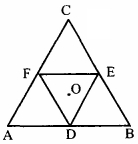
The equilateral triangle $ABC$ is cut from a thin solid sheet of wood. (See figure) $D, E$ and $F$ are the mid points of its sides as shown and $G$ is the centre of the triangle. The moment of inertia of the triangle about an axis passing through $G$ and perpendicular to the plane of the triangle is $I_0.$ If the smaller triangle $DEF$ is removed from $ABC,$ the moment of inertia of the remaining figure about the same axis is $I.$ Then
  • $I = \frac{{15}}{{16}}{I_0}$
  • B
    $I = \frac{{3}}{{4}}{I_0}$
  • C
    $I = \frac{{9}}{{16}}{I_0}$
  • D
    $I = \frac{{{I_0}}}{4}$

Answer

Correct option: A.
$I = \frac{{15}}{{16}}{I_0}$
a
$I\, \propto \,m{\ell ^2}\,\,\,\,\,\,\left( {let\,\sigma  = mass\,present\,area} \right)$

$\therefore \,\,\,{I_1}\, \propto \,{\ell ^4}\,\,\,\,\,\,\,...\left( 1 \right)$

$and\,\,{I_2}\, \propto \,{\left( {\frac{\ell }{2}} \right)^4}\,\,\,\,\,\,\,\,...\left( 2 \right)$

$So,\,{I_2} = \frac{I}{{16}}$

Moment of inertia of remaining sheet = $I - \frac{1}{{16}}$

$ = \frac{{151}}{{16}}$

Need a full question paper?

Generate a complete, print-ready paper with questions like this in minutes — across 16+ boards, with answer keys.

Start Generating Free

Similar questions

The displacement of simple harmonic oscillator after $3$ seconds starting from its mean position is equal to half of its amplitude. The time period of harmonic motion is $\dots \; s$
Two bodies $A$ & $B$ rotate about an axis, such that angle $\theta_A$ (in radians) covered by first body is proportional to square of time, & $\theta_B$ (in radians) covered by second body varies linearly. At $t = 0, \theta \,A = \theta \,B = 0$. If $A$ completes its first revolution in $\sqrt \pi$ sec. & $B$ needs $4\pi \,sec$. to complete half revolution then; angular velocity $\omega_A : \omega_B$ at $t = 5\, sec$. are in the ratio
A stone dropped from a building of height $h$ and it reaches after $t$ seconds on earth. From the same building if two stones are thrown (one upwards and other downwards) with the same velocity $u$ and they reach the earth surface after ${t_1}$ and ${t_2}$ seconds respectively, then
Consider the following two equations:

  1. $\overrightarrow{\text{R}}=\frac{1}{\text{M}}\sum\limits_{\text{i}}\text{m}_\text{i}\overrightarrow{\text{r}}_\text{i}$

  2. $\overrightarrow{\text{a}}_\text{cm}=\frac{\overrightarrow{\text{F}}}{\text{M}}$

In a noninertial frame

  1. Both are correct.
  2. Both are wrong.
  3. A is correct but B is wrong.
  4. B is correct but A is wrong.
All the graphs below are intended to represent the same motion. One of them does it incorrectly. Pick it up.
The displacement of a particle along the $x-$ axis is given by $x=asin^2$$\omega t$ . The motion of the particle corresponds to 
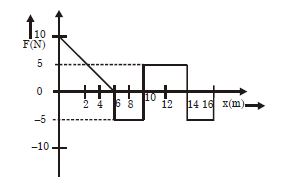
A particle is acted upon by a force $F$ which varies with position $x$ as shown in figure. If the particle at $x = 0$ has kinetic energy of $25\,J$ , then the kinetic energy of the particle at $x = 16\,m$ is .............. $\mathrm{J}$
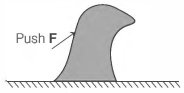
A small child tries to move a large rubber toy placed on the ground. The toy does not move but gets deformed under her pushing force $F$, which is obliquely upward as shown in the figure.Then, 
Hanging in a spring m the period of oscillation of the mass is T. Oscillations are made by cutting the spring in half and hanging double the mass on it. Now the period of oscillation will be :
One end of a string of length $L$ is tied to the ceiling of a lift accelerating upwards with an acceleration $2g$. The other end of the string is free. The linear mass density of the string varies linearly from $0$ to $\lambda$ from bottom to top.