Question
The equivalent capacitance between A and B is
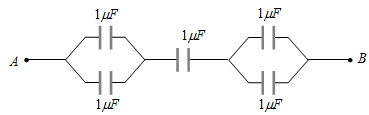
|
(a) 2 μF |
(b) 3 μF |
(c) 5 μF |
(d) 0.5 μF |
The equivalent capacitance between A and B is
|
(a) 2 μF |
(b) 3 μF |
(c) 5 μF |
(d) 0.5 μF |
(d) 0.5 μF
Generate a complete, print-ready paper with questions like this in minutes — across 16+ boards, with answer keys.
In a metre bridge experiment null point is obtained at 20 cm from one end of the wire when resistance X is balanced against another resistance Y. If X < Y, then where will be the new position of the null point from the same end, if one decides to balance a resistance of 4X against Y
|
(a) 50 cm |
(b) 80 cm |
(c) 40 cm |
(d) 70 cm |
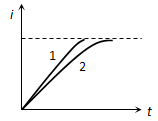
When a certain circuit consisting of a constant e.m.f. E an inductance L and a resistance R is closed, the current in, it increases with time according to curve 1. After one parameter (E, L or R) is changed, the increase in current follows curve 2 when the circuit is closed second time. Which parameter was changed and in what direction
|
(a) L is increased |
(b) L is decreased |
(c) R is increased |
(d) R is decreased |
Two non-ideal identical batteries are connected in parallel. Consider the following statements
(i) The equivalent e.m.f. is smaller than either of the two e.m.f.s
(ii) The equivalent internal resistance is smaller than either of the two internal resistances
|
(a) Both (i) and (ii) are correct |
(b) (i) is correct but (ii) is wrong |
|
(c) (ii) is correct but (i) is wrong |
(d) Both (i) and (ii) are wrong |
$\frac{\text{l}_1+\text{l}_2}{2}$
$\sqrt{\text{l}_2\text{l}_2}$
$\frac{\text{l}_1\text{T}_2-\text{l}_2\text{T}_1}{\text{T}_2-\text{T}_1}$
$\frac{\text{l}_1\text{T}_2+\text{l}_2\text{T}_1}{\text{T}_2+\text{T}_1}$
In an amplifier the load resistance  is equal to the plate resistance (
 . The voltage amplification is equal to
|
(a) μ |
(b) 2 μ |
(c) μ/2 |
(d) μ/4 |
The maximum wavelength of radiation that can produce photoelectric effect in a certain metal is 200 nm. The maximum kinetic energy acquired by electron due to radiation of wavelength 100 nm will be
|
(a) 12.4 eV |
(b) 6.2 eV |
(c) 100 eV |
(d) 200 eV |
An elementary particle of mass m and charge +e is projected with velocity v at a much more massive particle of charge Ze, where Z > 0. What is the closest possible approach of the incident particle
|
(a) |
(b) |
(c) |
(d) |


