MCQ
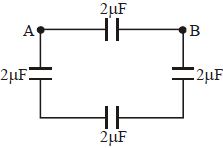
The equivalent capacitance between the points $A$ and $B$ in the given diagram is
  • A
    $8\,\mu F$
  • B
    $6\,\mu F$
  • $\frac{8}{3}\,\mu F$
  • D
    $\frac{3}{8}\,\mu F$

Answer

Correct option: C.
$\frac{8}{3}\,\mu F$
c
Series parallel combination

Need a full question paper?

Generate a complete, print-ready paper with questions like this in minutes — across 16+ boards, with answer keys.

Start Generating Free

Similar questions

An archaeologist analyses the wood in a prehistoric structure and finds that ${C^{14}}$ (Half life $= 5700\, years$) to ${C^{12}} $ is only one- fourth of that found in the cells buried plants. The age of the wood is about ........$years$
In dispersion without deviation
A defective eye cannot see close objects clearly because their image is formed
A concave mirror of radius of curvature $R$ has a circular outline of radius $r$. A circular disc is to be placed normal to the axis at the focus, so that it collects all the light that is reflected from the mirror from a beam parallel to the axis. For $r \ll R$, the area of this disc has to be at least
A block of mass $M$ placed inside a box descends vertically with acceleration $'a'$. The block exerts a force equal to one-fourth of its weight on the floor of the box. The value of $'a'$ will be .............
$A$ thin lens with focal length $f$ to be used as a magnifying glass. Which of the following statements regarding the situation is true?
A cricket player catches a ball of mass $120 g$ moving with $25 m / s$ speed. If the catching process is completed in $0.1 s$ then the magnitude of force exerted by the ball on the hand of player will be $($in $SI$ unit$):$
In a simple harmonic oscillation, what fraction of total mechanical energy is in the form of kinetic energy, when the particle is midway between mean and extreme position.
A hollow metallic sphere of radius $R$ is given a charge $Q$. Then the potential at the centre is
The temperature dependence of resistances of $Cu$ and undoped $Si$ in the temperature range $300-400\;K$, is best described by