MCQ
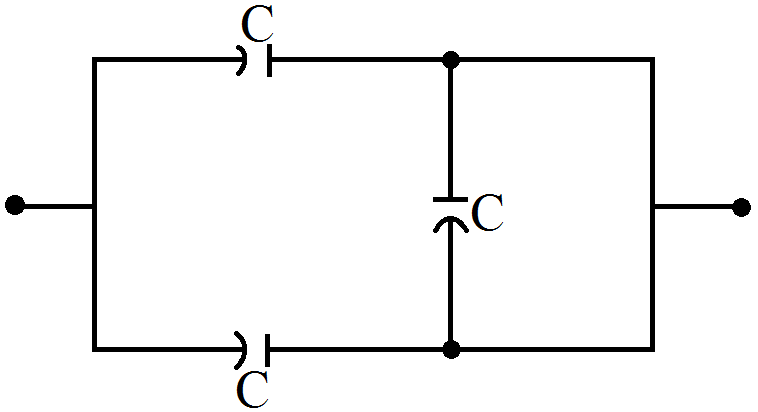
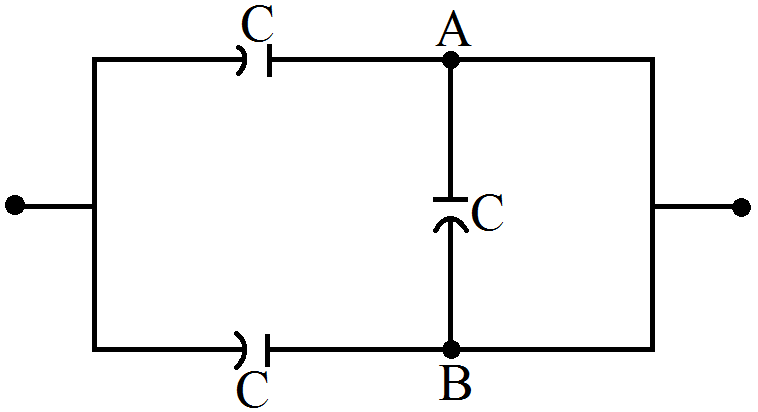
The equivalent capacitance of the combination shown in figure is:
  • A
    $C$
  • $2C$
  • C
    $\frac{\text{C}}{2}$
  • D
    None of these.

Answer

Correct option: B.
$2C$

Since the potential at point $A$ is equal to the potential at point $B$, no current will flow along arm $AB.$
Hence, the capacitor on arm $AB$ will not contribute to the circuit.
Also, because the remaining two capacitors are connected in parallel.
the net capacitance of the circuit is given by
$C_{eq} = C + C = 2C$

Need a full question paper?

Generate a complete, print-ready paper with questions like this in minutes — across 16+ boards, with answer keys.
Start Generating Free

Similar questions

When a glass rod is rubbed with a piece of silk cloth the rod ?
The impurity atoms with which pure silicon may be doped to make it a p-type semiconductor are those of:
Light is a form of _______ that we can detect with our ________ .
Fusion reaction is initiated with the help of(a) Low temperature(b) High temperature(c) Neutrons(d) Any particle
       
The mutual inductance between two coils is 1.25 henry. If the current in the primary changes at the rate of 80 ampere/second, then the induced e.m.f. in the secondary is(a)  12.5 V(b) 64.0 V(c)  0.016 V(d) 100.0 V
       
Susceptibility is positive and large for a:
A wire of length L and 3 identical cells of negligible internal resistances are connected in series.  Due to current, the temperature of the wire is raised by ∆ T in a time t.  A number N of similar cells is now connected in series with a wire of the same material and cross – section but of length 2 L.  The temperature of the wire is raised by the same amount ∆ T in the same time t.  the value of N is(a) 4(b) 6(c) 8  (d) 9
       
What is the momentum of a photon having frequency $1.5 \times 10^{13} \mathrm{~Hz}$
 
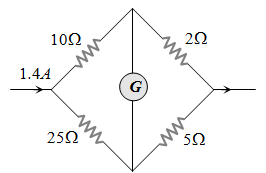
In the circuit shown in the figure, the current flowing in $2 \Omega$ resistance
A convex lens is dipped in a liquid whose refractive index is equal to the refractive index of the lens.  Then its focal length will(a) Become infinite (b) Become small, but non–zero(c) Remain unchanged (d) Become zero