MCQ
The equivalent capacitance of the combination shown in figure is:
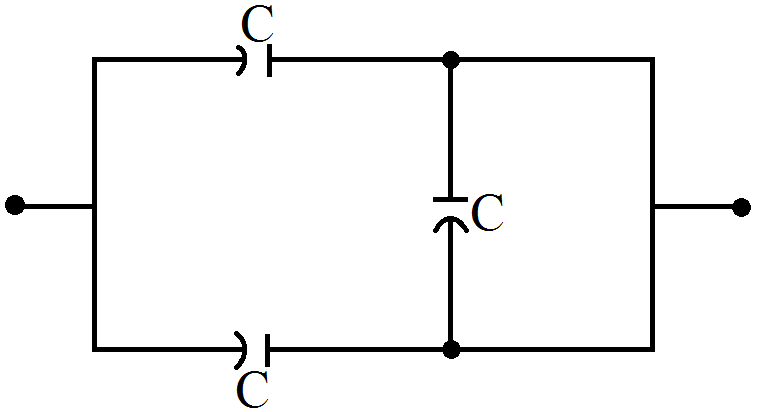
- AC
- B2C
- C$\frac{\text{C}}{2}$
- DNone of these.
Explanation:
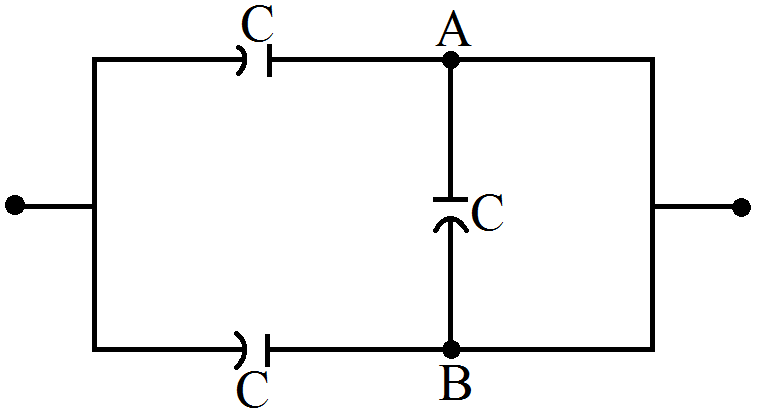
Since the potential at point A is equal to the potential at point B, no current will flow along arm AB. Hence, the capacitor on arm AB will not contribute to the circuit. Also, because the remaining two capacitors are connected in parallel, the net capacitance of the circuit is given by
Ceq = C + C = 2C
Generate a complete, print-ready paper with questions like this in minutes — across 16+ boards, with answer keys.
When light rays are incident on a prism at an angle of 45°, the minimum deviation is obtained. If refractive index of the material of prism is  , then the angle of prism will be
|
(a) 30° |
(b) 40° |
(c) 50° |
(d) 60° |
Assertion : Diamond glitters brilliantly.
Reason : Diamond does not absorb sunlight.
|
(a) If both assertion and reason are true and the reason is the correct explanation of the assertion. |
|
(b) If both assertion and reason are true but reason is not the correct explanation of the assertion. |
|
(c) If assertion is true but reason is false. |
|
(d) If the assertion and reason both are false. |
In a movie hall, the distance between the projector and the screen is increased by 1% illumination on the screen is
|
(a) Increased by 1% |
(b) Decreased by 1% |
(c) Increased by 2% |
(d) Decreased by 2% |