MCQ
The equivalent conductance of $NaCl $ at concentration $C$ and at infinite dilution are $\lambda _C$ and $\lambda _{\infty}$ respectively. The correct relationship between $\lambda _C$ and $\lambda _{\infty}$ is given as :

(Where the constant $B$ is positive)

  • A
    $\lambda _C =\lambda _{\infty} +(B)C$
  • B
    $\lambda _C =\lambda _{\infty} - (B)C$
  • $\lambda _C =\lambda _{\infty} -(B) \sqrt{C}$
  • D
    $\lambda _C =\lambda _{\infty} +(B) \sqrt{C}$
Answer

Correct option: C.
$\lambda _C =\lambda _{\infty} -(B) \sqrt{C}$
c
According to Debye Huckle onsager equation,

$\lambda_{C}=\lambda_{\infty}-B \sqrt{C}$

Need a full question paper?

Generate a complete, print-ready paper with questions like this in minutes — across 16+ boards, with answer keys.

Start Generating Free

Similar questions

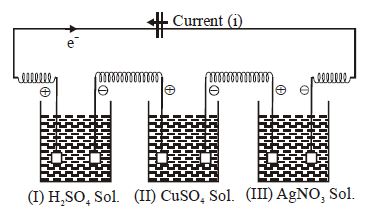
Three voltameters containing and aqueous solution of $H_2SO_4,$ $CuSO_4$ and $AgNO_3$ are connected in the following way

A current was passed for $10$ hours. $10.8\ g\ Ag$ was deposited at cathode in $(III)$ electrolytic cell during electrolysis if current efficiency is $50\%.$

What is magnitude of the current in ampere ?

Which of the following order of given properties is incorrect
Saponification of ethyl benzoate with caustic soda as alkali gives
The work done during the expansion of a gas from a volume of $4\,d{m^3}$ to $6\,d{m^3}$ against a constant external pressure of $3\,atm$ is ($1\,L\,atm\, = 101.32\,J$) ......$J$
The major product formed in the following reaction is :
Image
If first orbit energy of $H{e^ + }$ is $-54.4 \,eV$, then the second orbit energy will be ............. $\mathrm{eV}$
An ideal gas is allowed to expand from $1\, L$ to $10\, L$ against a constant external pressure of $1\,bar$. The work done in $kJ$ is
A certain buffer solution contains equal concentration of ${X^ - }$ and $HX$. The ${K_a}$ for $HX$ is ${10^{ - 8}}$. The $pH$ of the buffer is
Ionization energy increases in the order
The statement$(s)$ that are correct about the species $\mathrm{O}^{2-}, \mathrm{F}^{-}, \mathrm{Na}^{+}$and $\mathrm{Mg}^{2+}$.

$(A)$ All are isoelectronic

$(B)$ All have the same nuclear charge

$(C)$ $\mathrm{O}^{2-}$ has the largest ionic radii

$(D)$ $\mathrm{Mg}^{2+}$ has the smallest ionic radii

Choose the most appropriate answer from the options given below :