MCQ
The equivalent resistance and potential difference between $A$ and $B$ for the circuit is respectively
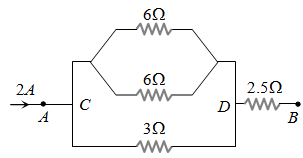
  • $4 \Omega, 8 \mathrm{V}$
  • B
    $8 \Omega, 4 \mathrm{V}$
  • C
    $2 \Omega, 2 \mathrm{V}$
  • D
    $16 \Omega, 8 \mathrm{V}$

Answer

Correct option: A.
$4 \Omega, 8 \mathrm{V}$

Need a full question paper?

Generate a complete, print-ready paper with questions like this in minutes — across 16+ boards, with answer keys.
Start Generating Free

Similar questions

To measure the field $B$ between the poles of an electromagnet, a small test loop of area $1\ cm^2,$ resistance $10\Omega$ and $20$ turns is pulled out of it. A galvanometer shows that a total charge of $2\mu\text{c}$ passed through the loop. The value of $B$ is
A hollow sphere of charge does not produce an electric field at any(a) Point beyond 2 metres(b) Point beyond 10 metres(c) Interior point(d) Outer point
   
   
Fusion reaction takes place at very high temperature because$:$
Two wires of resistance $R_1$ and $R_2$ have temperature coefficient of resistance ${\alpha_1}$ and ${\alpha_2}$, respectively. These are joined in series. The effective temperature coefficient of resistance is
An antenna is a device (a) That converts electromagnetic energy into radio frequency signal(b) That converts radio frequency signal into electromagnetic energy(c) That converts guided electromagnetic waves into free space electromagnetic waves and vice-versa(d) None of these


The charge on proton is:
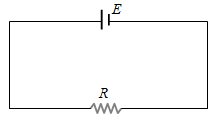
Consider the circuit given here with the following parameters $E.M.F.$ of the cell $= 12\ V.$
Internal resistance of the cell  $= 2 \Omega.$ Resistance $R = 4 \Omega$

Which one of the following statements in true
The mechanism of the hydrogen bomb is based on(a) Fission of isotopes of hydrogen(b) Fusion of protons(c) Fusion of deutrium and tritium(d) Fusion of neutrons
   
   
The resonant frequency of an L - C circuit is.
Which of the following subatomic particle is lightest?