MCQ
The error in measuring the current with a tangent galvanometer is minimum when the deflection is about
  • A
    $ 0^{\circ} $
  • B
    $ 30^{\circ} $
  • $ 45^{\circ} $
  • D
    $ 60^{\circ}$

Answer

Correct option: C.
$ 45^{\circ} $
$ 45^{\circ} $

Need a full question paper?

Generate a complete, print-ready paper with questions like this in minutes — across 16+ boards, with answer keys.

Start Generating Free

Similar questions

Two electric dipoles of moment $P$ and $64 \,P$ are placed in opposite direction on a line at a distance of $25$ $cm$. The electric field will be zero at point between the dipoles whose distance from the dipole of moment $P$ is.....$cm$
The radius of germanium $(Ge)$ nuclide is measured to be twice the radius of ${}_4^9Be$ . The number of nucleons in $Ge$ are
A proton and a deutron both having the same kinetic energy, enter perpendicularly into a uniform magnetic field $B$. For motion of proton and deutron on circular path of radius ${R_p}$ and ${R_d}$ respectively, the correct statement is
A nichrome wire 50 cm long and one square millimetre cross-section carries a current of 4A when connected to a 2V battery. The resistivity of nichrome wire in ohm metre is
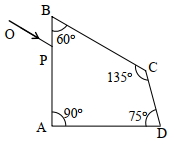
A ray $\mathrm{OP}$ of monochromatic light is incident on the face $\mathrm{AB}$ of prism $\mathrm{ABCD}$ near vertex $\mathrm{B}$ at an incident angle of $60^{\circ}$ (see figure). If the refractive index of the material of the prism is $\sqrt{3}$, which of the following is (are) correct? $Image$

$(A)$ The ray gets totally internally reflected at face $CD$

$(B)$ The ray comes out through face $\mathrm{AD}$

$(C)$ The angle between the incident ray and the emergent ray is $90^{\circ}$

$(D)$ The angle between the incident ray and the emergent ray is $120^{\circ}$
Sun maintains its shining because of:
The electric field component of an electromagnetic wave in vaccum is given as $\vec E = 3\cos \,\left( {1.8y + 5.4 \times {{10}^8}\,t} \right)\hat i$ Its direction of propagation and wavelength is 
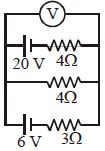
What will be reading of voltmeter ................. $V$
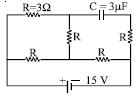
In the circuit shown, the cell is ideal, with $emf$ $=$ $15$ $V$. Each resistance is of $3 $ $\Omega$ . The potential difference across the capacitor is.....$V$
Which of the following quantities are always positive in a simple harmonic motion?