MCQ
The ether that undergoes electrophilic substitution reactions is
  • A
    $C{H_3}O{C_2}{H_5}$
  • ${C_6}{H_5}OC{H_3}$
  • C
    $C{H_3}OC{H_3}$
  • D
    ${C_2}{H_5}O{C_2}{H_5}$

Answer

Correct option: B.
${C_6}{H_5}OC{H_3}$
b
(b) Only alkyl aryl ethers e.g., ${C_6}{H_5}OC{H_3}$ undergoes electrophilic substitution reactions.

Need a full question paper?

Generate a complete, print-ready paper with questions like this in minutes — across 16+ boards, with answer keys.
Start Generating Free

Similar questions

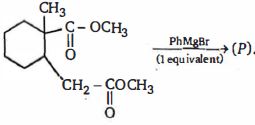
product $P$ is
Which of the following is correct with respect to $-I$ effect of the substituents ? ($R =$ alkyl)
The bond angle in water molecule is nearly or Directed bonds in water forms an angle of
Formic acid and acetic acid can be distinguished by
An aqueous solution of a solute $AB$ has normal boiling point of $101.08\,^oC$ and normal freezing point of $- 1.80\,^oC$. Hence,$ AB$

Given : $AB$ is $100\%$ ionised at boiling point of the solution, ($K_b / K_f $) water $= 0.3$

The number of molecule at $NTP$ in $1\, ml$ of an ideal gas will be
Consider the following reaction

${C_6}{H_6}(l)\, + \,\frac{{15}}{2}\,{O_2}(g)\, \to \,6\,C{O_2}(g)\, + \,3{H_2}O\,(g)$

Signs of $\Delta H,\,\Delta S$ and $\Delta G$ for the above reaction will be
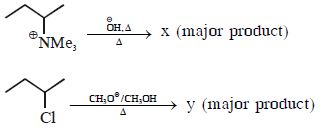
Which statement is correct ?
Based on $VSEPR$ model, match the xenon compounds given in $List-I$ with the corresponding. geometries and the number of lone pairs on xenon given in $List-II$ and choose the correct option.
$List-I$ $List-II$
($P$) $XeF _2$ ($1$) Trigonal bipyramidal and two lone pair of electrons
($Q$) $XeF _4$ ($2$) Tetrahedral and one lone pair of electrons
($R$) $XeO _3$ ($3$) Octahedral and two lone pair of electrons
($S$) $XeO _3 F _2$ ($4$) Trigonal bipyramidal and no lone pair of electrons
  ($5$) Trigonal bipyramidal and three lone pair of electrons
Which of the following compounds have the same no. of lone pairs with their central  atom?
$(I)\, XeF^-_5$   $(II)\, BrF_3$   $(III)\, XeF_2$   $(IV)\, H_3S^+$  $(V)$ Triple Methylene