MCQ
The ether that undergoes electrophilic substitution reactions is
  • $C_6H_5OCH_3$
  • B
    $CH_3OC_2H_5$
  • C
    $CH_3OCH_3$
  • D
    $C_2H_5OC_2H_5$

Answer

Correct option: A.
$C_6H_5OCH_3$
a
Only aromatic ethers or alkyl aryl ethers undergo electrophilic substitution reactions.

Need a full question paper?

Generate a complete, print-ready paper with questions like this in minutes — across 16+ boards, with answer keys.

Start Generating Free

Similar questions

The correct structure of ethylenediaminetetraacetic acid $(EDTA)$ is
Alkyl halide is converted into alkyl isocyanide by reaction with
The standard reduction potentials at $298 \mathrm{~K}$ for the following half cells are given below :

$\mathrm{Cr}_2 \mathrm{O}_7{ }^{2-}+14 \mathrm{H}^{+}+6 \mathrm{e}^{-} \rightarrow 2 \mathrm{Cr}^{3+}+7 \mathrm{H}_2 \mathrm{O}, \mathrm{E}^{\circ}=1.33 \mathrm{~V}$

$\mathrm{Fe}^{3+}(\mathrm{aq})+3 \mathrm{e}^{-} \rightarrow \mathrm{Fe}  \mathrm{E}^{\circ}=-0.04 \mathrm{~V}$

$\mathrm{Ni}^{2+}(\mathrm{aq})+2 \mathrm{e}^{-} \rightarrow \mathrm{Ni}  \mathrm{E}^{\circ}=-0.25 \mathrm{~V}$

$\mathrm{Ag}^{+}(\mathrm{aq})+\mathrm{e}^{-} \rightarrow \mathrm{Ag} \mathrm{E}^{\circ}=0.80 \mathrm{~V}$

$\mathrm{Au}^{3+}(\mathrm{aq})+3 \mathrm{e}^{-} \rightarrow \mathrm{Au} \mathrm{E}^{\circ}=1.40 \mathrm{~V}$

Consider the given electrochemical reactions, The number of metal$(s)$ which will be oxidized be $\mathrm{Cr}_2 \mathrm{O}_7{ }^{2-}$, in aqueous solution is. . . . . . 
Which of the following process does not produce ammonia gas
The compound in which ${C^*}$ uses $s{p^3}$ hybrids for bond formation is
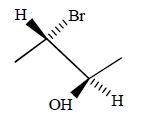
$I.U.P.A.C.$ name of above compound
At $298 K$, the limiting molar conductivity of a weak monobasic acid is $4 \times 10^2 S cm ^2 mol ^{-1}$. At $298 K$, for an aqueous solution of the acid the degree of dissociation of $\alpha$ and the molar conductivity is $y \times 10^2 S cm ^2 mol ^{-1}$. At $298 K$, upon $20$ times dilution with water, the molar conductivity of the solution becomes $3 y \times 10^2 S cm ^2 mol ^{-1}$.

($1$) The value of $\alpha$ is. . . . . . 

($2$) The value of $y$ is. . . . . . .

Give the answer or quetion ($1$) and ($2$)
When ${H_2}S$ gas is passed through nitric acid, the product is
Which of the following compounds is ionic
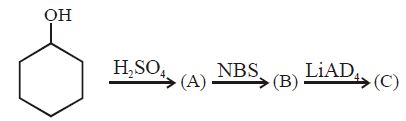
product ($C$) is