MCQ
The ether that undergoes electrophilic substitution reactions is
- A$C{H_3}O{C_2}{H_5}$
- ✓${C_6}{H_5}OC{H_3}$
- C$C{H_3}OC{H_3}$
- D${C_2}{H_5}O{C_2}{H_5}$
Generate a complete, print-ready paper with questions like this in minutes — across 16+ boards, with answer keys.
Which forms di-iodide on reaction with $HI $ (excess) ?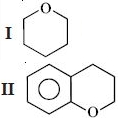
Benzaldehyde, Acetaldehyde, Acetone, Acetophenone,Methanal, $4-$nitrobenzaldehyde, cyclohexane carbaldehyde.
$R =8.3\, J \, K ^{-1}\, mol ^{-1}$
$(A)$ Upon heating, $H _3 PO _3$ undergoes disproportionation reaction to produce $H _3 PO _4$ and $PH _3$.
$(B)$ While $H _3 PO _3$ can act as reducing agent, $H _3 PO _4$ cannot.
$(C)$ $H _3 PO _3$ is a monobasic acid.
$(D)$ The $H$ atom of $P - H$ bond in $H _3 PO _3$ is not ionizable in water.
$r = \frac{{ - d\left[ A \right]}}{{dt}} = K\,{\left[ A \right]^{\frac{1}{2}}}\,{\left[ B \right]^{\frac{1}{2}}}\,{\left[ C \right]^{\frac{1}{4}}}$
The order of reaction is