MCQ
The excess pressure inside a soap bubble is thrice the excess pressure inside a second soap bubble. The ratio between the volume of the first and the second bubble is:
  • A
    $1: 9$
  • B
    $1: 3$
  • C
    $1: 81$
  • $1: 27$

Answer

Correct option: D.
$1: 27$
d
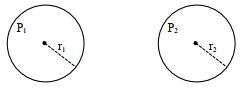
$\mathrm{P}_1-\mathrm{P}_0=\frac{4 \mathrm{~T}}{\mathrm{r}_1} \quad \mathrm{P}_2-\mathrm{P}_0=\frac{4 \mathrm{~T}}{\mathrm{r}_2}$

$\mathrm{P}_1-\mathrm{P}_0=3\left(\mathrm{P}_2-\mathrm{P}_0\right)$

$\frac{4 \mathrm{~T}}{\mathrm{r}_1}=3 \frac{4 \mathrm{~T}}{\mathrm{r}_2}$

$\mathrm{r}_2=3 \mathrm{r}_1$

$\frac{\mathrm{V}_1}{\mathrm{~V}_2}=\frac{\frac{4}{3} \pi \mathrm{r}_1^3}{\frac{4}{3} \pi \mathrm{r}_2^3}=\frac{1}{27}$
Need a full question paper?

Generate a complete, print-ready paper with questions like this in minutes — across 16+ boards, with answer keys.

Start Generating Free

Similar questions

A body has speed $V, 2\,V$ and $3\,V$ in first $1/3$ of distance $S$, second $1/3$ of $S$ and third $1/3$ of $S$ respectively. Its average speed will be :-
A physical quantity is measured and its value is found to be $nu$ where $n = $ numerical value and $u = $ unit. Then which of the following relations is true
The angular velocity of rotation of star (of mass $M$ and radius $R$) at which the matter start to escape from its equator will be
A chain of length $L$ rests on a rough table. If $\mu $ be the coefficient of friction, the maximum friction of the chain that can hang over the table will be
A sphere of density $\rho $ , specific heat capacity $c$ and radius $r$ is hung by a thermally insulating thread in an enclosure which is kept at a lower temperature than the sphere. The temperature of the sphere starts to drop at a rate which depends upon the temperature difference between the sphere and the enclosure and the nature of the surface of sphere and is proportional to
The maximum load a wire can withstand without breaking, when its length is reduced to half of its original length, will
  1. Be double.
  2. Be half.
  3. Be four times.
  4. Remain same.
A particle performs uniform circular motion with an angular momentum $L.$  If the angular frequency of the particle is doubled and kinetic energy is halved, its angular momentum becomes
In case of a moving body:
Velocity of sound measured at a given temperature in oxygen and hydrogen is in the ratio
A stone of mass $m$, tied to the end of a string , is whirled around in a circle on a horizontal frictionless table. The length of the string is reduced gradually keeping the angular momentum of the stone about the centre of the circle constant. Then , the tension in the string is given by $T\, = Ar^n$, where $A$ is a constant, $r$ is the instantaneous radius of the circle. The value of $n$ is equal to