MCQ
The explosion of hydrogen bomb is based on the principle of:
- AUncontrolled fission reaction
- BNuclear fusion reaction
- CControlled fission reaction
- DPhotoelectric effect
Explanation:
Nuclear fusion is a reaction in which two or more atomic nuclei come close enough to form one or more different atomic nuclei and subatomic particles (neutrons and/or protons).
The difference in mass between the products and reactants is manifested as the release of large amounts of energy.
A hydrogen bomb derives its energy from this type of nuclear reaction.
Generate a complete, print-ready paper with questions like this in minutes — across 16+ boards, with answer keys.
Two lenses have focal lengths  and
and  and their dispersive powers are
  and
and  respectively. They will together form an achromatic combination if
|
(a) |
(b) |
|
(c) |
(d) |
Assertion : The energy of charged particle moving in a uniform magnetic field does not change.
Reason : Work done by magnetic field on the charge is zero.
|
(a) If both assertion and reason are true and the reason is the correct explanation of the assertion. |
|
(b) If both assertion and reason are true but reason is not the correct explanation of the assertion. |
|
(c) If assertion is true but reason is false. |
|
(d) If the assertion and reason both are false. |
A particle of charge +q and mass m moving under the influence of a uniform electric field  and a uniform magnetic field
  follows trajectory from P to Q as shown in figure. The velocities at P and Q are v
 and -2v
 respectively. Which of the following statement(s) is/are correct
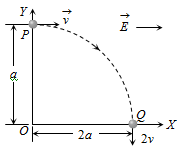
|
(a) E = |
|
(b) Rate of work done by electric field at P is |
|
(c) Rate of work done by both the fields at Q is zero |
|
(d) a, b, c |
Light of frequency n is incident on a substance of threshold frequency n0(n0 < n). The energy of the emitted photo-electron will be
|
(a) |
(b) h/v |
(c) |
(d) |
In Young's double slit experiment when wavelength used is 6000 Å and the screen is 40 cm from the slits, the fringes are 0.012 cm wide. What is the distance between the slits
|
(a) 0.024 cm |
(b) 2.4 cm |
(c) 0.24 cm |
(d) 0.2 cm |
The peak voltage in the output of a half-wave diode rectifier fed with a sinusoidal signal without filter is 10 V. The dc component of the output voltage is
|
(a) 10/ |
(b) 10/p V |
(c) 10 V |
(d) 20/p V |


