MCQ
The expression $(a - b)^3 + (b - c)^3 + (c - a)^3$ can be factorized as:
  • A
    $(a - b)(b - c)(c - a)$
  • $3(a - b)(b - c)(c - a)$
  • C
    $-3(a - b)(b - c)(c - a)$
  • D
    $(a + b + c)(a^2 + b^2 + c^2 - ab - bc - ca)$

Answer

Correct option: B.
$3(a - b)(b - c)(c - a)$
By we know that $a^3 + b^3 + c^3 - 3abc$
$= (a + b + c)(a^2 + b^2 + c^2 - ab - bc - ca)$
If $a + b + c = 0$, then
$a^3 + b^3 + c^3 = 3abc$
In given expression,
Let $a - b = A, b - c = B, c - a = C$
Now, $a - b + b - c + c - a = 0$
i.e.$ A + B + C = 0$
$\Rightarrow A^3 + B^3 + C^3 = 3\text{ABC}$
$\Rightarrow (a - b)^3 + (b - c)^3 + (c - a)^3 $
$= 3(a - b)(b - c)(c - a)$
Hence, correct option is $(b).$

Need a full question paper?

Generate a complete, print-ready paper with questions like this in minutes — across 16+ boards, with answer keys.
Start Generating Free

Similar questions

The base of a triangular field is three times its altitude. If the cost of sowing the field at $₹ 58$ per hectare is $₹ 783$, find its base and height.
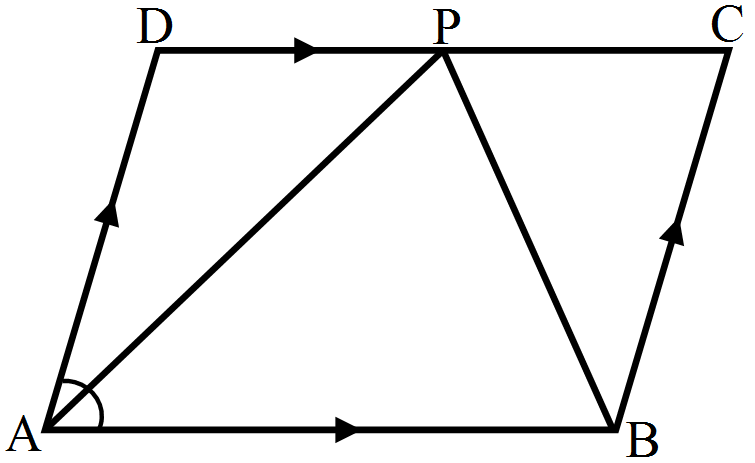
In the adjoining figure, $\text{ABCD}$ is a parallelogram in which $\angle\text{A}=60^{\circ}.$ If the bisectors of $\angle\text{A}$ and $\angle\text{B}$ meet $DC$ at $P$, prove that
$i. \angle\text{APB}=90^{\circ},$
$ii. AD = DP$ and $PB = PC = BC$,
$iii. DC = 2AD$.
A family with a monthly income of $₹. 20,000$ had planned the following expenditures per month under various heads:
Heads Expenditure $($in thousand rupees$)$
Grocery $4$
Rent $5$
Education of children $5$
Medicine $5$
Fuel $2$
Entertainment $1$
Miscellaneous $1$
Draw a bar graph for the data above.
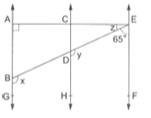
In the given figure, $AB \| CD \| EF , \angle D B G=x, \angle E D H=y, \angle A E B=z, \angle E A B=90^{\circ}$ and $\angle B E F=65^{\circ}$. Find the values of $x , y$ and z .
Image
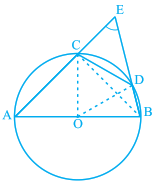
In given figure, $AB$ is a diameter of the circle, $CD$ is a chord equal to the radius of the circle. $AC$ and $BD$ when extended intersect at point $E$. Prove that $\angle AEB = 60^\circ .$
​​​​​​​
Following table gives the distribution of students of sections $A$ and $B$ of a class according to the marks obtained by them.
Section A
Section B
Marks
Frequency
Marks
Frequency
$0-15$
$15-30$
$30-45$
$45-60$
$60-75$
$75-90$
$5$
$12$
$28$
$30$
$35$
$13$
$0-15$
$15-30$
$30-45$
$45-60$
$60-75$
$75-90$
$3$
$16$
$25$
$27$
$40$
$10$
Represent the marks of the students of both the sections on the same graph by two frequency polygons.What do you observe?
A cloth having an area of $165\ m^2$ is shaped into the form of a conical tent of radius $5\ m$. $\Big($Use$\ \pi=\frac{22}{7}\Big).$
$i.$ How many students can sit in the tent if a student, on an average, occupies $\frac{5}{7}\text{m}^2$ on the ground?
$ii.$ Find the volume of the cone.
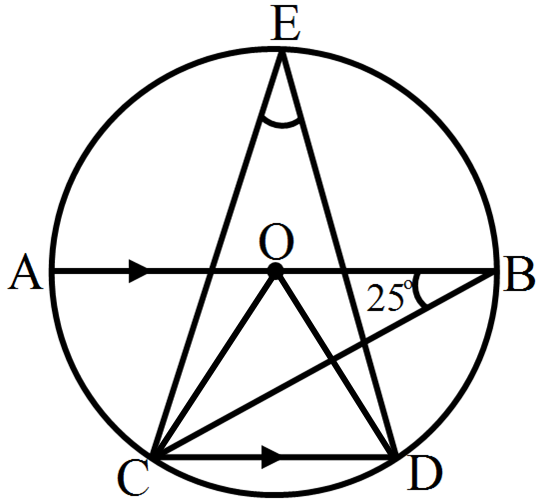
In the adjoining figure, $O$ is the centre of a circle. Chord $CD$ is parallel to diameter $AB$. If $\angle\text{ABC}=25^\circ,$ calculate $\angle\text{CED}.$
Prove that the diameter of a circle perpendicular to one of the two parallel chords of a circle is perpendicular to the other and bisects it.
The following observed values of $x$ and $y$ are thought to satisfy a linear equation. Write the linear equation
$x$ $6$ $-6$
$y$ $-2$ $6$
Draw the graph, using the values of $x, y$ as given in the above table. At what points the graph of the linear equation
$i.$ Cuts the $X-$axis$?$
$ii.$ Cuts the $Y- $axis$?$