The fact that the conductance of some metals rises to infinity at some temperature below a few Kelvin is called
Easy


Download our appand get started for free
Experience the future of education. Simply download our apps or reach out to us for more information. Let's shape the future of learning together!No signup needed.*
Similar Questions
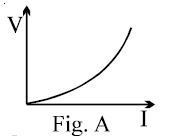
- 1The variation of current $(I)$ and voltage $(V)$ is as shown in figure $A$. The variation of power $P$ with current $I$ is best shown by which of the following graphView Solution
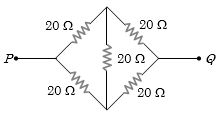
- 2The equivalent resistance between $P$ and $Q$ in the given figure, is ............... $\Omega$View Solution
- 3You are given three bulbs of $25$, $40$ and $60\, watt$. Which of them has lowest resistanceView Solution
- 4A resistance wire connected in the left gap of a meter bridge balances a $10\, \Omega$ resistance in the right gap at a point which divides the bridge wire in the ratio $3: 2 .$ If the length of the resistance wire is $1.5 m ,$ then the length of $1\, \Omega$ of the resistance wire is $....... \times 10^{-2}\;m$View Solution
- 5There are $n$ similar conductors each of resistance $R$. The resultant resistance comes out to be $x$ when connected in parallel. If they are connected in series, the resistance comes out to beView Solution
- 6The resistance of a wire is $R$. It is bent at the middle by $180^{\circ}$ and both the ends are twisted together to make a shorter wire. The resistance of the new wire isView Solution
- 7View SolutionThe material of wire of potentiometer is
- 8If $2.2\,kW$ power is transmitted through a $100\,\Omega $ line at $22,000\,V,$ the power loss in the form of heat will be ............. $W$View Solution
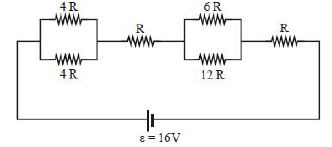
- 9The resistive network shown below is connected to a $D.C.$ source of $16\, V$. The power consumed by the network is $4\, Watt$. The value of $R$ is ............. $\Omega$View Solution
- 10The charge flowing in a conductor varies with time as $Q = at -bt^2$. Then for current, which statement is incorrect.View Solution
$(A)$ decreases linearly with time
$(B)$ reaches a maximum and then decreases
$(C)$ fall to zero after time $t = a/2b$
$(D)$ changes at a rate $-2b$
Options :