The far point of a myopic person is 80 cm in front of the eye. What is the nature and power of the lens required to correct the problem?
Download our app for free and get started
The person is suffering from an eye defect called myopia. In this defect, the image is formed in front of the retina. Hence, a concave lens is used to correct this defect of vision. Object distance, u = infinity = $\infty$ Image distance, v = - 80 cm Focal length = f According to the lens formula,$\frac{1}{\text{v}}-\frac{1}{\text{u}}=\frac{1}{\text{f}}$
$-\frac{1}{80}-\frac{1}{\infty}=\frac{1}{\text{f}}$
$\frac{1}{\text{f}}=-\frac{1}{80}$
$\text{f} = -80 \text{ cm} = -0.8\text{ cm}$
We know, Power, $\text{P}=\frac{1}{\text{f(in metres)}}$$\text{P}=\frac{1}{-0.8}=-1.25 \ \text{D}$
A concave lens of power -1.25 D is required by the person to correct his defect.
$-\frac{1}{80}-\frac{1}{\infty}=\frac{1}{\text{f}}$
$\frac{1}{\text{f}}=-\frac{1}{80}$
$\text{f} = -80 \text{ cm} = -0.8\text{ cm}$
We know, Power, $\text{P}=\frac{1}{\text{f(in metres)}}$$\text{P}=\frac{1}{-0.8}=-1.25 \ \text{D}$
A concave lens of power -1.25 D is required by the person to correct his defect.

Download our appand get started for free
Experience the future of education. Simply download our apps or reach out to us for more information. Let's shape the future of learning together!No signup needed.*
Similar Questions
- 1View SolutionName the part of the eye where the image is formed by the eye lens. What is the nature of the image formed? How is this image sent to the brain?
- 2View SolutionThe eyes of a person are focused
- On a nearby object, and
- On a distant object, turn by turn. In which case:
- The focal length of ye-lens will be the maximum?
- The converging power of eye-lens will be the maximum?
- 3View SolutionWhat is tyndall effect? Explain with an example?
- 4View SolutionWhat are the two most common defects of vision (or defects of eye)? How are they corrected?
- 5View SolutionWrite the function of each of the following parts of human eye.
- Cornea.
- Iris.
- Crystalline lens.
- Ciliary muscles.
- 6View SolutionA narrow beam of light produces a spectrum XY on passing through a triangular glass prism.
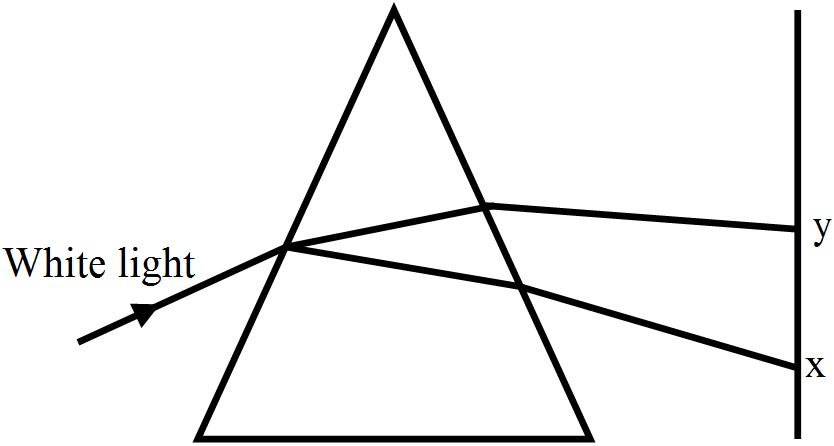
- State the colour at X and Y.
- Why do the different components of white light bend through different angles with respect to the incident beam of light?
- 7View SolutionState the role of ciliary muscles in accommodation.
- 8View SolutionDraw a ray diagram to show the refraction of light through a glass prism. Mark on it,
- The incident ray,
- The emergent ray,
- The angle of deviation.
- 9View SolutionWhy does the eye-lens not have to do all the work of converging incoming light rays?
- 10View SolutionHow many surfaces bound a prism? How many refractions does a beam of white light suffer, when it is passed through a prism?