MCQ
The feasible region corresponding to the linear constraints of a Linear Programming Problem is given belowImage
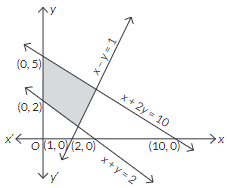
Which of the following is not a constraint to the given Linear Programming Problem?
  • A
    $x+y \geq 2$
  • B
    $x+2 y \leq 10$
  • C
    $x-y \geq 1$
  • D
    $x-y \leq 1$

Answer

We observe, $(0,0)$ does not satisfy the inequality
$x-y \geq 1$
So, the half plane represented by the above inequality will not contain origin therefore, it will not contain the shaded feasible region.

Need a full question paper?

Generate a complete, print-ready paper with questions like this in minutes — across 16+ boards, with answer keys.

Start Generating Free

Similar questions

Choose the correct answer from the given four options: If $y=x^4-10$ and if $x$ changes from $2$ to $1.99,$ what is the change in $y:$
$\int_{}^{} {x\sqrt {\frac{{1 - {x^2}}}{{1 + {x^2}}}} } \;dx = $
The inverse of $y=5^{\log x}$ is
Choose the correct answer from the given four options.
The feasible solution for a LPP is shown in. Let Z = 3x - 4y be the objective function.

Minimum of Z occurs at:
Directions : In the following questions, the Assertions $(A)$ and Reason $(s)\ (R)$ have been put forward. Read both the statements carefully and choose the correct alternative from the following :
Assertion $ (A) : \frac{\text{d}}{\text{dx}}(\text{x}^2+\text{x}+1)^4=(\text{x}^2+\text{x}+1)^3(2\text{x}+1)$
Reason $ (R) : (\text{fog}\ '=\text{f '}[\text{g(x)}].\text{g '(x)}$
Let $\{x\}$ and $[x]$ denote the fractional part of $x$ and the greatest integer $\leq x$ respectively of a real number $x$. If $\int \limits_{0}^{n}\{x\} d x, \int \limits_{0}^{n}[x] d x$ and $10\left( n ^{2}- n \right),( n \in N , n >1)$ are three consecutive terms of a $G.P.$, then $n$ is equal to
If $A=\left(\begin{array}{cc}\frac{1}{\sqrt{5}} & \frac{2}{\sqrt{5}} \\ \frac{-2}{\sqrt{5}} & \frac{1}{\sqrt{5}}\end{array}\right), B=\left(\begin{array}{ll}1 & 0 \\ i & 1\end{array}\right), i=\sqrt{-1}$, and

$\mathrm{Q}=\mathrm{A}^{\mathrm{T}} \mathrm{BA}$, then the inverse of the matrix $\mathrm{A} \mathrm{Q}^{2021} \mathrm{~A}^{\mathrm{T}}$ is equal to :

If $f(x) = \left\{ {\begin{array}{*{20}{c}}
{x\left[ x \right],\,\,\,\,\,\,\,\,\,\,\,\,\,}&{0 \le x < 2}\\
{\left( {x - 1} \right)\left[ x \right]\,,\,\,\,}&{2 \le x \le 4}
\end{array}} \right.,$ where $[.]$ denotes greatest integer function, then
Degree of the given differential equation ${\left( {\frac{{{d^2}y}}{{d{x^2}}}} \right)^3} = {\left( {1 + \frac{{dy}}{{dx}}} \right)^{1/2}}$, is
The value of $\int\frac{\sin\text{x}+\cos\text{x}}{\sqrt{1-\sin2\text{x}}}\text{ dx}$ is equal to: