MCQ
The feasible solution for a $LPP$ is shown in Figure Let $z=3 x-4 y$ be the objective function. Minimum of $Z$ occurs at $....$
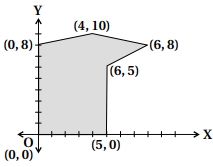
  • A
    $(0,0)$
  • $(0,8)$
  • C
    $(5,0)$
  • D
    $(4,10)$

Answer

Correct option: B.
$(0,8)$
b
$(B) \,\,(0,8)$

Corner point

Objective function

$z=3 x-4 y$

$(0,0)$ $z=3(0)-4(0)=0$
$(5,0)$ $z=3(5)-4(0)=15$ (Maximum value)
$(6,5)$ $z=3(6)-4(5)=18-20=-2$
$(6,8)$ $z=3(6)-4(8)=-14$
$(4,10)$ $z=3(4)-4(10)=-28$
$(0,8)$ $z=3(0)-4(8)=-32($ minimum value )

Minimum value of the objective function is $-32$

$\therefore$ Minimum value exists at point $(0,8).$


Need a full question paper?

Generate a complete, print-ready paper with questions like this in minutes — across 16+ boards, with answer keys.

Start Generating Free

Similar questions

In the $X Y$-plane, three distinct lines $l_1, l_2, l_3$ concur at a point $(\lambda, 0)$. Further the lines $l_1, l_2, l_3$ are normals to the parabola $y^2=6 x$ at the points $A=\left(x_1, y_1\right)$, $B=\left(x_2, y_2\right), C=\left(x_3, y_3\right)$ respectively. Then, we have
If $A_1, A_3, ..... A_{2n - 1}$ are $n$ skew symmetric matrices of same order then $B =$$\sum\limits_{r = 1}^n {(2r - 1){{({A_{2r - 1}})}^{2r - 1}}} $ will be
A circle is inscribed in an equilateral triangle of side $a$, the area of any square inscribed in the circle is
If $\frac{ dy }{ dx }+2 y \tan x =\sin x , 0< x <\frac{\pi}{2}$ and $y \left(\frac{\pi}{3}\right)=$ 0 , then the maximum value of $y(x)$ is.
The number of solutions, of the equation $e ^{\sin x }-2 e ^{-\sin x }=2$ is
If ${{\log x} \over {b - c}} = {{\log y} \over {c - a}} = {{\log z} \over {a - b}},$ then which of the following is true
The value of the integral $\int\limits_{ - 2}^2 {\frac{{{{\sin }^2}\,x}}{{\left[ {\frac{x}{\pi }} \right] + \frac{1}{2}}}\,\,dx} $ (where $[x]$ denotes the greatest integer less than or equal to $x$ ) is
The angles $\alpha, \beta, \gamma$ of a triangle satisfy the equations $2 \sin \alpha+3 \cos \beta=3 \sqrt{2}$ and $3 \sin \beta+2 \cos \alpha=1$. Then, angle $\gamma$ equals
In the expansion of ${\left( {{x^2} - 2x} \right)^{10}}$, the coefficient of ${x^{16}}$ is
The order and degree of the differential equation ${\left[ {4 + {{\left( {\frac{{dy}}{{dx}}} \right)}^2}} \right]^{2/3}} = \frac{{{d^2}y}}{{d{x^2}}}$ are